
If your garage door suddenly won’t lift, you heard a loud bang from the garage, or the opener hums but the door barely moves, a snapped spring is the most likely cause. Stop using the door, unplug the opener, and keep your hands away from the spring and the cables. A broken spring can’t be repaired, only replaced, and the replacement is a job for a trained technician because of the energy stored in the spring.
Below you’ll find how to confirm the diagnosis, what is safe to do yourself, what replacement typically costs, and what happens when a technician arrives.
TL;DR
- A snapped spring is replaced, never repaired. Unplug the opener and don’t run the door.
- Look for a visible gap in a torsion spring above the door, a loud bang, a door that feels extremely heavy, or an opener that strains.
- National averages run $150 to $350 for a single door, with a pair of torsion springs often $200 to $500. Your final price depends on the door and the parts.
- Replace both springs on a two-spring door, even if only one broke.
- Don’t attempt the winding yourself. Call a local technician; we offer same-day and 24/7 emergency service in Colorado Springs and nearby.
Table of Contents
- How to tell the spring is really the problem
- What to do in the first ten minutes
- Why the spring broke
- Why you shouldn’t replace it yourself
- What replacement costs
- Replace both springs, even if only one broke
- What a technician does on the visit
- Our perspective: treat springs as a maintenance item
- When we can help
- Preventing the next break
- FAQ
- Sources
How to tell the spring is really the problem
A garage door is heavy, often well over a hundred pounds for a standard steel two-car door. The springs do the lifting. The opener mostly guides the door along its track. When a spring lets go, the opener is suddenly asked to lift the full weight, and it usually can’t.
Common signs of a snapped spring:
- A loud bang from the garage. Many homeowners describe it as something like a firecracker or a gunshot. It’s often the first sign, sometimes heard from inside the house.
- A visible gap in the spring. On a torsion system, the coil sits on a metal bar above the door opening. A break shows up as a gap of an inch or more in the coil.
- A door that won’t rise or only lifts a few inches. The opener motor runs but the door barely moves.
- A door that feels very heavy when lifted by hand, or one that slams shut.
- Slack or loose cables hanging near the bottom corners of the door.
- An opener that strains, jerks or reverses.
If you see these signs but no gap, the cause could be a cable off its drum, a bent track or a failed opener. A technician can sort that out in minutes. What matters is the same in every case: don’t keep forcing the door.
Torsion springs and extension springs
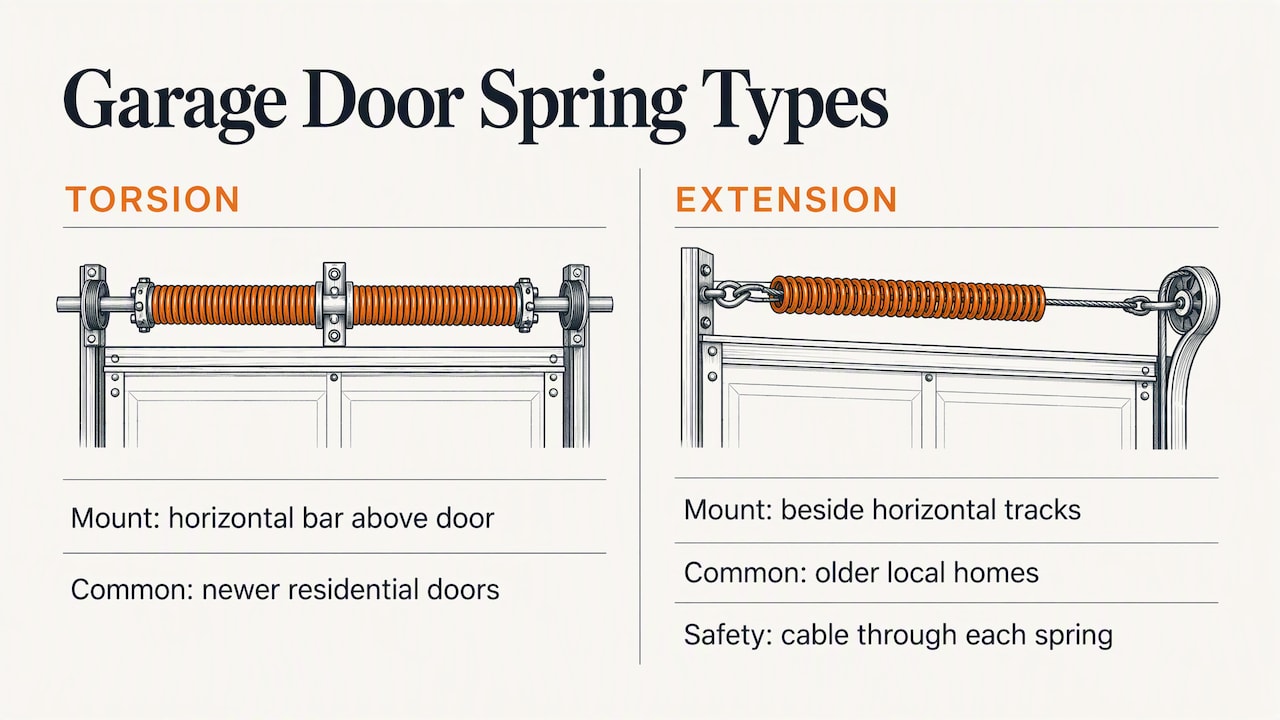
There are two main spring systems. Torsion springs are mounted horizontally on a bar above the door. Extension springs run along the sides of the horizontal tracks. Most newer residential doors use torsion springs, while many older doors in Colorado Springs neighborhoods still have extension springs.
The difference matters for safety. Extension springs should have safety cables running through them so a snapped spring doesn’t snap back across the garage. If you have extension springs and don’t see a cable threaded through each one, mention it to your technician when they arrive.
What to do in the first ten minutes
The sequence below follows the standard safe order described by the Garage Door Handbook. Everything on this list works only on the opener and the door’s release. None of it touches the spring.
- Stop. Don’t press the wall button again and again. An opener trying to lift an unbalanced door can damage itself or the door.
- Unplug the opener so it can’t start on its own, from a remote, a keypad or a phone app.
- Keep people and pets away from the door, especially if it’s partly open. A door without spring support can drop quickly.
- Check whether the door is fully closed. If it is, leave it closed. If it’s open, don’t stand or park under it.
- Look, don’t touch. Use a flashlight to check the springs, cables and drums from a safe distance.
- Call a technician and tell them what you saw: the bang, the gap, the door type, and whether the car is trapped inside.
Can you still open the door by hand?
Sometimes, but it is a bad idea unless you have to. With a broken spring, the door can be several times heavier than normal. Using the red emergency release cord to disconnect the door from the opener lets you move the door manually, but only do that with the door fully closed or fully lowered, and with a helper. If the door is partly raised, releasing the opener can let it fall.
If you need your car out of a closed garage, lift slowly with two people, brace the door open and don’t leave it unsupported. Then have the springs replaced before you use the door again. Don’t lift with your fingers near the section joints, since they can pinch hard.
Why the spring broke
Springs are consumables. Clopay notes that a typical spring is rated for about 10,000 cycles, which works out to roughly 7 to 10 years of standard use. One cycle is one open and one close. If your household opens the door four times a day, you reach 10,000 in under seven years.
The usual causes:
- Normal wear. Metal fatigues with every cycle. This is the most common reason.
- High use. Rental properties, busy households and businesses with deliveries wear springs out faster.
- Rust and friction. Moisture and dust make the coils rub. Winter slush and de-icer carried in on vehicles don’t help.
- Cold snaps. Metal gets more brittle in low temperatures, and springs often fail on the first cold mornings of the year. That’s a pattern our technicians see across the Pikes Peak region, where temperatures can swing widely within a day.
- Incorrect springs. A spring that doesn’t match the door’s weight wears out early or never balances the door properly.
- Poor-quality parts. Cheaper springs often have a lower cycle rating.
You can check your own door’s balance when it’s healthy. With the door closed and the opener disconnected, lift it by hand to waist height. A balanced door stays put. If it drifts down or shoots up, the springs are wearing and the door needs service before it fails.
Why you shouldn’t replace it yourself
We know videos make this look like a one-hour project. It isn’t a project we’d recommend, and we don’t say that just because we sell the service.
A wound torsion spring stores a lot of energy. Industry guidance puts it at more than 200 ft-lbs, and the winding bars slip when you make a small error. OSHA’s incident database includes cases of workers hit by door springs. One OSHA accident summary describes an employee who lacerated an arm after being struck by a door spring. Those are trained workers. A homeowner with a ladder and a set of bars has less margin.
There is also the matter of the right part. Springs are sized by wire diameter, coil length, inside diameter and winding direction, matched to your door’s weight. A spring that is only close will lift the door badly and wear the opener. Hardware-store springs often aren’t sized for your specific door.
What’s reasonable to do yourself: unplug the opener, photograph the label and the spring, measure the door, and write down what you heard. That makes a phone call faster and the quote more accurate.
What replacement costs
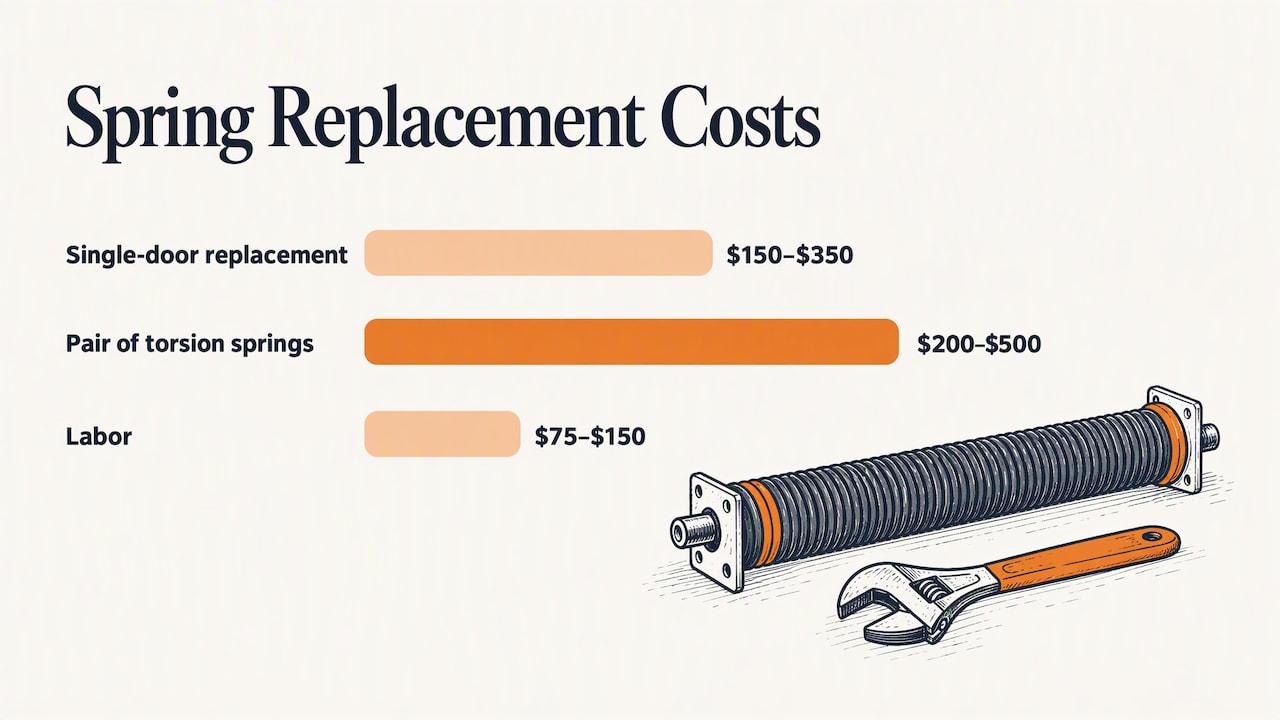
Published national figures give a useful ballpark. According to Angi’s 2026 data, replacing springs on a single door usually runs from $150 to $350, and a pair of torsion springs commonly costs $200 to $500 when done professionally. Labor is typically $75 to $150 of that.
What moves the price up or down:
| Factor | Effect on price |
|---|---|
| One door or two | Each door is priced separately |
| Torsion or extension springs | Torsion systems usually cost more in parts and labor |
| Spring size and cycle rating | Heavier doors and higher-cycle springs cost more |
| Damaged cables, drums or bearings | Parts that often get replaced during the same visit |
| After-hours or emergency call | Urgent timing can affect the quote |
| Door weight and type | Insulated and wood doors need stronger springs |
We don’t publish fixed prices, because the right quote depends on your actual door. What we do promise is an upfront price with no hidden fees before work starts. If a quote arrives with a vague total, ask what it includes: parts, labor, cables, rollers and the safety check.
Beware of unusually low figures. A very low advertised price often covers a single cheap spring and leaves the rest as add-ons.
Replace both springs, even if only one broke
Many doors use two torsion springs. When one breaks, people ask whether they can replace just that one. You can, technically. Technicians strongly advise against it. Both springs have been through the same number of cycles, so the survivor is likely close to the end of its life and often fails soon after. Replacing one means a second service call, and a second bill, in a few months.
A matched pair also balances the door evenly. A new spring paired with a worn one can leave the door lopsided and put stress on the cables and rollers.
What a technician does on the visit
A typical spring replacement by a professional goes roughly like this:
- Inspection. The technician checks the door’s weight, springs, cables, drums, rollers, hinges and tracks, then confirms the spring is the problem.
- Quote. You get the price for the right parts before work begins.
- Safe release of tension from any remaining spring.
- Removal of the broken spring and its hardware as needed.
- Installation of correctly sized springs, with new cables or bearings if they show wear.
- Winding and balance test. The door should stay put at mid-height, then lift and close smoothly.
- Opener check. The opener’s force settings and safety reversal get tested, since a strain from the broken spring may have affected them.
- Lubrication and cleanup.
A straightforward replacement is usually a matter of an hour or two, though a door with additional damage takes longer. If the door came off its track when the spring broke, expect a bit more time and parts.
Our perspective: treat springs as a maintenance item
We repair garage doors across Colorado Springs, Fountain, Monument, Pueblo and the surrounding area, and most of our emergency calls start the same way: a bang, a stuck car and a homeowner who didn’t know springs wear out.
Three things we’d tell any neighbor:
- Know your spring’s age. If your house is nearing a decade old and the door gets daily use, the springs are already on borrowed time. Replace them on your schedule, not at 7 a.m. on a work day.
- Don’t treat the opener as the problem. Many people spend money on a new opener when the springs are the real culprit. The motor isn’t supposed to do the lifting.
- Quality matters more than the lowest price. Parts of the right size and cycle rating cost a bit more up front and last longer. Our technicians are local and know how Colorado’s cold mornings and dry air affect hardware, so we size and inspect with that in mind. You can read more on our page about quality parts and friendly technicians.
A service visit once a year, with a balance test and lubrication, costs far less than an emergency call and a damaged car or door.
— shalev
When we can help
If the door is stuck right now, our spring replacement service covers torsion and extension springs for homes, rentals and commercial doors, with same-day visits and 24/7 emergency response. If the spring failure bent a track or damaged the door, our garage door repair team handles that in the same visit. And if the opener was damaged by repeated strain, see our opener repair and installation page. For doors that are old, dented or beyond economical repair, we also do new garage door installation.
Property managers, landlords and real estate agents: we can handle tenant calls and pre-sale repairs. Tell us about the property when you call.
Preventing the next break
- Lubricate the springs a couple of times a year with a garage door lubricant, not general-purpose grease.
- Listen for new squeaks, scraping or popping.
- Test the balance twice a year with the opener disconnected and the door closed.
- Keep the door’s weight stable. Adding insulation or a heavy new panel changes how much the springs must lift.
- Remove snow and ice from the base of the door, so the door and springs aren’t fighting a frozen bottom seal.
- Schedule inspections for doors older than about seven years or used many times a day.
FAQ
Can a garage door open with a broken spring?
The opener may lift it a few inches or not at all, and forcing it can burn out the motor or damage the door. You can open it manually after disconnecting the opener with the release cord, but the door will be very heavy and can drop. Keep fingers and feet clear and get the spring replaced before regular use.
Can you replace just one garage door spring?
It’s possible, but we don’t recommend it. The second spring has the same cycle count and is probably near failure. Replacing both gives you an evenly balanced door and avoids a second visit.
How much does it cost to replace a broken garage door spring?
National figures from Angi run $150 to $350 for a single door and $200 to $500 for a pair of torsion springs, with labor often $75 to $150. Local pricing depends on door size, spring type and added parts. Ask for the full price, including labor, before work begins.
How long do garage door springs last?
A standard spring is rated for about 10,000 cycles, which Clopay equates to roughly 7 to 10 years for typical use. Households that open the door many times a day can reach that number sooner. Higher-cycle springs are available for busy doors.
Is a snapped spring an emergency?
It’s not a danger if you leave the door alone, but it can trap your car and leave the garage open or locked shut. Unplug the opener and call a pro. If the door is stuck open and the home is unsecured, say so when you call, so the technician can prioritize it.
Sources
- How Much Does Garage Door Spring Replacement Cost? | Angi
- Homeowners Guide to Garage Door Spring System | Clopay
- How do you fix a broken spring? | Garage Door Handbook
- Accident Report Detail | OSHA