
If your garage door cable is broken, stop using the door, keep your hands off the cable and the parts around it, and call a professional. The cables carry the weight of the door while under high spring tension, and a snapped or slipped cable can leave the door crooked, jammed, or ready to drop. In Colorado Springs, Monument, Fountain, and Security-Widefield, Pro Spring Garage Door handles cable replacement and the repairs that usually come with it. Call us at (719) 257-3379 and we will tell you what to expect.
This guide explains what a broken cable actually means, what causes it, how to spot trouble before the cable lets go, and what a technician checks when they arrive.
TL;DR
- A broken or snapped cable means the door has lost lifting support on one or both sides. Do not try to run it with the opener or by hand.
- Cables and springs work under high tension. Leave removal, adjustment, and replacement to trained technicians.
- Common causes include wear, rust, a damaged drum, a failing spring, and a door that has gone out of alignment.
- A good repair finds the reason the cable failed, not only the cable itself.
- We offer 24/7 emergency garage door service and same-day appointments subject to availability. Call (719) 257-3379.
Table of Contents
- What a garage door cable does
- What happens when a garage door cable breaks
- Warning signs before a cable fails
- Why garage door cables break
- Why you should not operate or fix it yourself
- What a technician checks during a cable repair
- Cable replacement or a bigger repair?
- Our perspective: fix the cause, not just the cable
- Garage door cable repair in Colorado Springs and nearby
- Request cable repair from Pro Spring Garage Door
- Preventing the next cable failure
- FAQ
- Sources
What a garage door cable does
Most residential sectional doors hang from two steel lift cables, one on each side. Each cable runs from a bracket at the bottom corner of the door up to a cable drum at the end of the torsion spring shaft (or to a pulley system on extension spring doors). As the door opens, the spring turns the drums, the cables wind onto them, and the door rises. As it closes, the cables unwind in a controlled way.
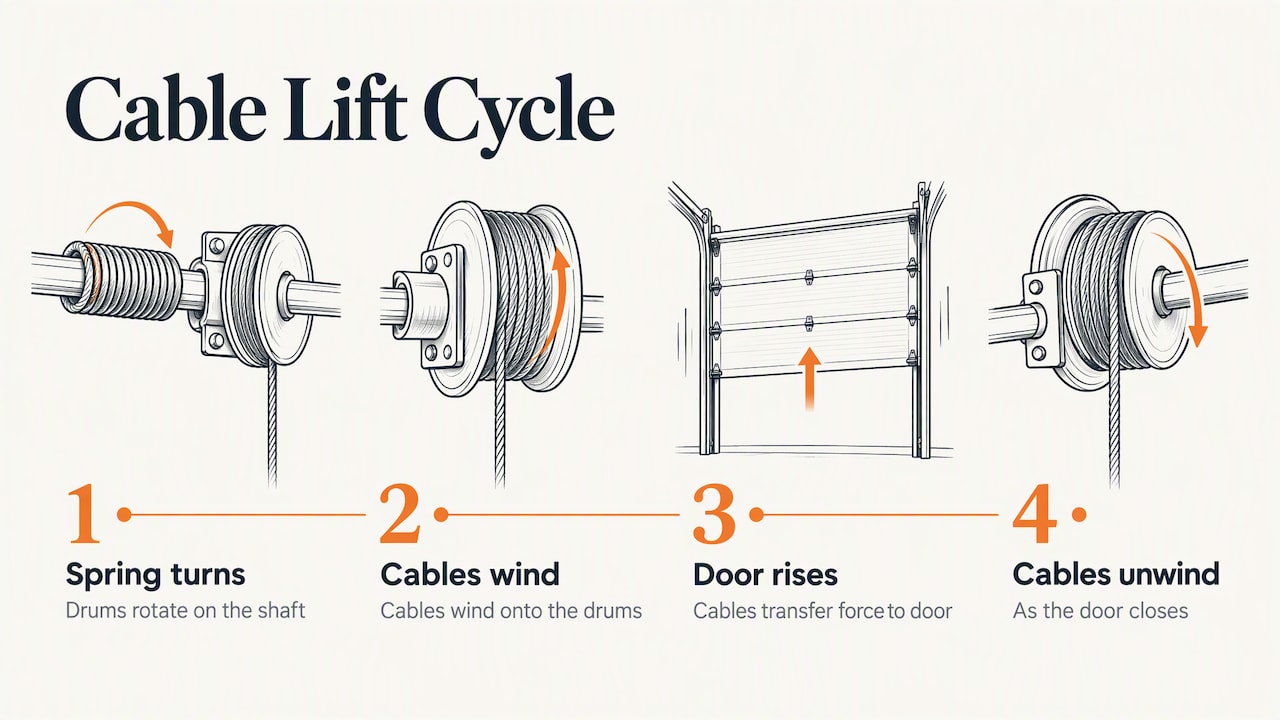
The corner brackets at the lower left and right of the door are where those cables typically attach, and that is why those brackets are under heavy load too. The spring does the lifting work. The cables transfer that force to the door and keep it balanced.
When a cable fails, the spring system is still wound and still storing energy, but the door is no longer held evenly. That is where the danger and the damage come from.
What happens when a garage door cable breaks
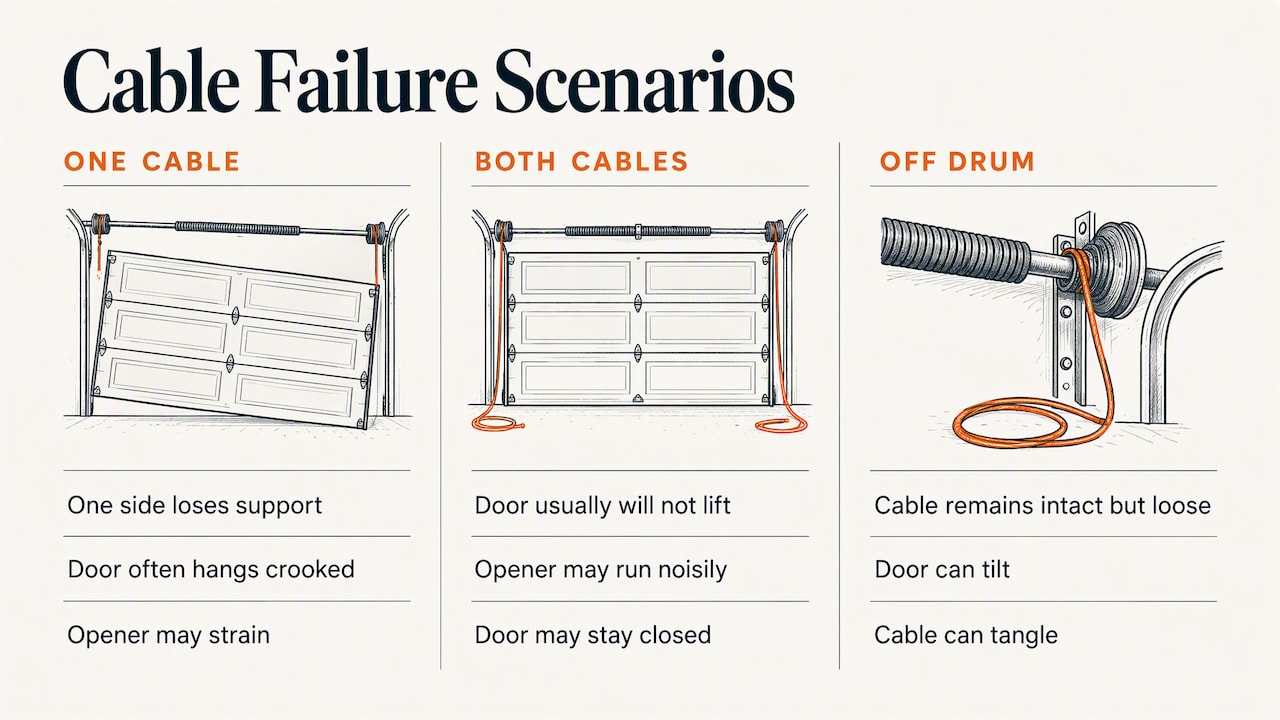
What you see depends on whether one cable or both let go.
One cable snaps. One side of the door loses support. The door often hangs crooked, with one bottom corner lower than the other. The opener may strain, the door may bind in the tracks, and the cable that is left carries far more than its share.
Both cables snap. The door usually will not lift at all. The opener may run and make noise while the door stays put, or the door may sit closed and refuse to budge.
A cable slips off the drum. The cable is intact but loose. The door can tilt, the cable can tangle, and the next attempt to move the door can damage the drum, track, or door panels.
In each case, a door that is stuck closed with your car inside, or stuck open with your home exposed, is a real inconvenience. Call us any time, day or night, because we offer 24/7 emergency garage door service.
Warning signs before a cable fails
Cables rarely break without hints. If you notice any of these, schedule an inspection before you are locked out:
- Fraying or broken strands. Visible wires sticking out along the cable. DASMA, the garage door industry’s trade association, advises visually checking the cables that connect the spring system to the bottom brackets, and says frayed or worn cables are in danger of breaking and can cause injury.
- Loose or slack cables. A cable that hangs with slack when the door is closed may have jumped the drum or lost spring tension.
- An uneven door. One side sits higher or lower, or the door looks tilted when it moves.
- Cables coming off the drum. The cable no longer sits in the drum’s grooves, or you can see it bunched or wrapped incorrectly.
- A door that will not open or close. Or one that starts moving and stops, jerks, or makes grinding sounds.
- Rust or discoloration. Dark, flaking, or pitted cable surfaces.
- A sudden loud bang. Many homeowners hear a snap from the garage and only later find the cause.
Look, do not touch. Visual checks from a safe distance are fine. Pulling on a cable, pushing it back onto a drum, or tightening a bracket is not.
Why garage door cables break
A cable is a consumable part, but cable failure usually has a reason behind it. Knowing the reason matters, because replacing only the cable can set you up for a repeat failure.
Normal wear
Every trip up and down flexes the cable and winds it onto the drum. Over years of daily use, individual strands break and the cable weakens. Doors that run many cycles a day, such as those on rental properties, offices, and shops, tend to show wear sooner.
Rust and corrosion
Moisture, road salt, and winter slush carried in on vehicles settle near the bottom brackets, where the cable ends. Rust weakens steel from the surface in. The bottom of the cable and the bracket area are the first places to check. Colorado’s freeze and thaw cycles can make that worse in a garage that is not heated.
Damaged or worn drums
The grooves in the drum guide the cable as it winds. A cracked, chipped, or worn drum can pinch the cable, let it jump the groove, or cause it to wind unevenly. A new cable on a damaged drum can fail again quickly.
Spring failure
A broken torsion spring changes the load on the whole system. When a spring breaks, the door drops weight onto cables that were never meant to hold it alone, and cables can slip, kink, or come off the drum in the process. The reverse can also happen: a snapped cable can disturb the spring and shaft. That is why we inspect both together. If you hear a loud bang and the door will not lift, see our spring replacement service.
Improper alignment
Bent tracks, a door that has been bumped by a vehicle, loose brackets, or an unbalanced door can pull the cables off line. When the door rides unevenly, one cable takes more strain, rubs on hardware, or loses its seat on the drum.
Poor installation or mismatched parts
Cables that are the wrong length, drums that are not set properly, or a spring wound unevenly can all cause trouble. Quality parts and careful setup matter. You can read about our approach on our quality parts and friendly technicians page.
Why you should not operate or fix it yourself
The most common question after a cable breaks is whether you can just lift the door by hand or press the button. Our answer is no, and the industry’s own guidance backs that up.
- The system is under high tension. Torsion springs store a lot of energy. DASMA’s inspection guidelines tell people to only visually inspect parts under spring tension, such as spring anchor brackets and the parts that cables attach to, and not to touch them because they are under extreme tension.
- Broken cables can still react. Residual tension can still cause a broken cable to snap or move, so even moving it out of the way is a risk.
- The door can fall. When cables fray or break, a door can drop unexpectedly or become stuck. A sectional door is heavy, and it can fall on a person, a pet, or a vehicle.
- The opener can be damaged. Running the opener against a door with no cable support strains the motor, the gears, and the door panels. It can bend the top section or the track.
- DIY mistakes compound. Putting a cable back on a drum without correcting the spring tension or the cause of the failure can lead to uneven lift and a second failure.
What you can safely do: stop using the door, keep children and pets away from it, keep cars out of its path if you can do so without touching it, and call a professional. If the door is partway open, do not walk or park under it.
What a technician checks during a cable repair
A proper cable repair is an inspection first and a parts swap second. When one of our technicians arrives, here is what the visit covers.
- The cables. Both sides, even if only one has broken. A cable that has matched the broken one for years of use is usually just as worn.
- The springs. Whether a spring has broken, lost tension, or is mismatched to the door’s weight. Spring and cable problems often show up together.
- The drums. Cracks, worn grooves, and loose set screws that let the cable wind badly.
- The bottom brackets and fasteners. Bent, rusted, or loose brackets where the cable attaches.
- Tracks and rollers. Bends, gaps, or debris that push the door out of line.
- Door balance and condition. Whether the door sits level and whether panels were damaged when the cable let go.
- The opener. Whether it was strained or damaged by attempts to run the door.
After the inspection, we explain what we found, what needs replacing, and what the work will involve before we start. Costs vary with the parts involved and the condition of the rest of the system, so we give a clear estimate for your door rather than a number that may not fit your situation.
Cable replacement or a bigger repair?
Sometimes a cable is the whole story. Other times it is the visible part of a larger issue. Here is how the common situations differ.
| Situation | What it often means | Typical next step |
|---|---|---|
| One cable frayed or snapped, rest of system in good shape | Normal wear or rust on that cable | Professional cable replacement, with the other cable and drums checked |
| Cable off the drum, no breakage | Slack from a spring problem, misalignment, or a worn drum | Find the cause, correct tension and alignment, replace damaged parts |
| Cable broke along with a spring | Spring failure shifted the load | Replace the spring and address cables and drums together |
| Door bent or panels damaged after cable failure | The door dropped or bound in the tracks | Repair or replace the damaged section, track, or door |
| Door old, repeatedly failing | Overall wear across components | Discuss repair versus a new garage door installation |
If your door is also slow, noisy, or the opener seems to struggle, the problem may extend beyond the cables. Our garage door repair and opener repair and installation services cover those related parts.
Our perspective: fix the cause, not just the cable
We see the same pattern again and again around Colorado Springs. A homeowner replaces or reports a single cable, and weeks later the other one lets go, or the new one frays because a drum was chewed up or a spring was out of balance. Cables are inexpensive parts compared with the trouble they cause when they fail, but the problem is rarely just the cable.
That is why we look at the full system: cables, springs, drums, brackets, tracks, and the door’s balance. We would rather spend a few extra minutes finding the cause than send you home with a door that fails again.
We also hold a firm line on safety. Garage door springs and cables operate under high tension, and we do not encourage anyone without training to adjust, remove, or replace them. You will not find us offering a “quick DIY fix” for a snapped cable, because there is not a safe one for an untrained person.
What you can expect from us is simple: dependable service, quality replacement parts, professional workmanship, and a clear estimate before we begin repairs. We are locally owned, and we know the doors, the weather, and the neighborhoods here.
— Sean Smith
Garage door cable repair in Colorado Springs and nearby
Pro Spring Garage Door provides residential and commercial garage door service across Colorado Springs and surrounding communities. That includes Monument, Fountain, and Security-Widefield, along with other nearby areas we serve such as Manitou Springs, Falcon, Woodland Park, Black Forest, and Cimarron Hills, as well as Pueblo and Pueblo West.
We work with homeowners, property managers, landlords, real estate agents, and businesses. If you manage rentals or a commercial building, a door that will not close is also a security and liability problem, so quick response matters. Same-day appointments are available subject to availability, and our 24/7 emergency service is there for the times a door fails at night, on a weekend, or with a car trapped inside.
Request cable repair from Pro Spring Garage Door
If your cable is broken, frayed, or off the drum, we can send a technician to inspect the door, explain what failed and why, and replace the cables and any related parts that need it. You get a clear estimate before work begins. Because cost depends on the parts and the condition of your door, we do not quote blanket numbers: call us and we will give you an estimate that fits your situation.
Call (719) 257-3379 to schedule service or request an estimate. You can also see all of our work on our garage door repair page.
Preventing the next cable failure
You cannot prevent every failure, but you can catch problems early.
- Look at the cables a few times a year. From the floor, check both sides for fraying, rust, or slack. Do not touch them. DASMA’s homeowner safety guidance recommends a visual check and calls in a professional for work on these parts.
- Watch how the door moves. Jerking, tilting, or a new noise is worth a call.
- Keep the area dry when possible. Wipe up salt and slush near the bottom corners.
- Do not ignore a broken spring. Spring and cable failures are linked, so fix both.
- Schedule preventive maintenance. A technician can check wear on the cables, drums, and brackets before they fail. Our team offers preventive maintenance as part of our services.
- Do not hang things from the door or hit the tracks. Impacts can bend hardware and pull cables out of line.
FAQ
Can I open a garage door with a broken cable?
We advise against it. With a cable broken, the door is no longer supported evenly, and forcing it with the opener or by hand can bend the tracks, damage panels, or let the door drop. Keep clear of the door and call a professional.
Can I replace a garage door cable myself?
We do not recommend it. The cables are connected to a spring system under high tension, and a mistake can cause serious injury. Industry guidance also calls this a job best left to professionals.
What should I do if the cable came off the drum but is not snapped?
Stop using the door and do not try to rewind the cable yourself. A cable off the drum usually points to a spring, drum, or alignment problem that needs to be found and corrected. A technician can reset it safely and check the rest of the system.
How much does it cost to replace a garage door cable?
It depends on the door, which parts are damaged, and whether springs, drums, or tracks also need work. We give a clear estimate before beginning repairs, so call (719) 257-3379 for one that fits your door.
Do you offer emergency service for a broken cable?
Yes. We offer 24/7 emergency garage door service in Colorado Springs and surrounding communities. Same-day appointments are available subject to availability.
Sources
- Garage Door Cable Replacement: Safety and Professional Advice, Clopay
- Garage Door Systems, DASMA safety tips
- TDS 151 General Code Inspection Guidelines for Garage Doors, DASMA
- Garage Door Safety, Raynor
This article is provided for general informational purposes only. Garage door springs, cables, and other components can be dangerous to repair without proper training and equipment. For professional garage door repairs, contact Pro Spring Garage Door at (719) 257-3379. We provide 24/7 emergency garage door services throughout Colorado Springs and surrounding communities.