
A dented garage door can often be repaired, but only after someone checks whether the dent is the whole problem. If the damage is limited to one panel and the tracks, hinges, rollers and springs are still in good shape, repair is usually realistic. If the panel is creased, cracked or separating, or the hardware around it took the hit too, replacing the panel or the door is the safer call. In Colorado Springs, where hail, icy driveways and tight garages all take a toll, we see both outcomes.
This guide explains how to read the damage, what to do (and not do) before a technician arrives, and how repair, panel replacement and full replacement compare.
TL;DR
- A dent is rarely just cosmetic. Industry guidance treats deformed sections, tracks or hardware as a reason to question whether the door is safe to operate.
- Shallow, rounded dents on a panel with sound hardware are the best candidates for repair. Creased, cracked or buckled panels usually call for a replacement panel or a new door.
- Never use the opener to force a dented or rubbing door, and never adjust springs or cables yourself. They are under high tension.
- Cost depends on the door, the panel and the hardware, so it varies from job to job. Call (719) 257-3379 for a personalized estimate.
- If the dent comes with a broken spring, frayed cable or a door off its track, treat it as an emergency. We offer 24/7 emergency garage door service, with same-day appointments subject to availability.
Table of Contents
- Why a dent is more than a cosmetic problem
- First, check the door without operating it
- Do not force a dented door with the opener
- When a dented door is an emergency
- What a technician checks before deciding
- Repair, panel replacement or a new door
- Why DIY dent fixes are a bad idea on a garage door
- Finish with a safety check
- What to do if you manage property or sell homes
- Why costs vary, and how to get a useful estimate
- Our perspective: look at the whole door
- Dented door in Colorado Springs? Call us
- FAQ
- Sources
Why a dent is more than a cosmetic problem
A garage door is the largest moving part of most homes, and it is balanced by springs that carry its weight. A dent usually comes from an impact: a bumper, a basketball, a hailstone, a shovel, a car rolling back. The force that pushes in a panel does not always stop at the panel.
The Door and Access Systems Manufacturers Association (DASMA) publishes a checklist for building occupants that lists dents or buckling in door sections as something to look for after an incident. It also notes that deformation of panels, tracks or hardware can make a door questionable to operate.
That is why a door can look fixable from the driveway and still be a problem. A section that has been pushed in can pull a hinge loose, nudge a roller out of its track or shift the geometry the springs depend on. The visible dent is just the part you can see.
First, check the door without operating it
Before you call anyone, spend two minutes looking. Keep the door closed if it is closed. Do not run it up and down to see what happens.
- Photograph the damage from inside and outside. Photos help a technician judge the problem and, if the damage was caused by a covered event, help your insurance conversation. DASMA’s safety tips recommend stopping use and contacting a trained technician if you see deformation or loose components.
- Look at the edges of the dent. A smooth, shallow depression is different from a sharp crease or a crack in the steel, aluminum or composite skin.
- Check the seams between sections. Gaps, separation or panels that no longer line up point to damage deeper than the surface.
- Look at the hinges, rollers and tracks nearest the impact. Bent hinges, rollers out of position or a track that looks bowed mean the hit reached the hardware.
- Note how the door behaves. Is it stuck, rubbing, crooked or making new sounds? Tell the technician exactly that.
What you should not do is touch the springs, cables or the brackets that hold them. Those parts are under high tension, and DASMA’s consumer checklist treats spring, cable and bracket work as technician-only. This matters most after an impact, because damage can transfer behind the dent to components carrying the door’s weight.
Do not force a dented door with the opener
It is tempting to press the wall button and see if the door still goes up. If the panel is rubbing the track or the door is crooked, that can make things worse. The opener does not make a damaged door safe. The U.S. Consumer Product Safety Commission (CPSC) says a binding or unbalanced door should be professionally serviced.
If the door will not move smoothly by hand, or will not stay open, leave it alone and keep people and vehicles clear.
When a dented door is an emergency
Some dents come with problems that cannot wait. Treat it as urgent if you see any of these:
- A broken spring, or a visible gap in the spring above the door
- A loose, frayed or slack cable
- A door that has come off its track or hangs crooked
- A door that will not stay open or drops when released
DASMA warns that springs are under high tension and says not to operate a door with a broken spring. Leave the door in a safe position if you can, keep everyone clear, and call a professional.
We provide 24/7 emergency garage door service across Colorado Springs and surrounding communities. If the dent came with a broken spring or damaged cable, call us at (719) 257-3379. Same-day appointments are available subject to our schedule that day.
What a technician checks before deciding
A professional does not just push the panel flat. The sequence DASMA lays out for trained technicians is to assess the door visually and operationally, then present the owner with all the viable repair and replacement options. In practice, the inspection covers:
- The closed door and its overall alignment
- Tracks, rollers and hinges near the damage
- Brackets and the mounting surfaces they are fastened to
- Cables and the spring system
- Each door section, including the dented one
- The surrounding framing
- The opener and its safety reversal
Only then does it make sense to decide between repairing the section, replacing a matching panel, or recommending a new door. That decision depends on three things: how the door is built, how bad the damage is, and whether the rest of the system is still sound.
Repair, panel replacement or a new door
Here is how the three paths usually compare. We do not publish prices, because they depend on the door and the damage, so this table compares the things you can judge for yourself.
| Dent repair | Panel replacement | New door | |
|---|---|---|---|
| Best for | Shallow, rounded dents on a sound panel | Creased, cracked, buckled or separated sections | Widespread damage, discontinued or mismatched panels, or hardware damage across the door |
| Hardware condition | Tracks, hinges, rollers and springs all serviceable | Hardware serviceable, panel beyond repair | Hardware and several sections affected |
| Appearance afterward | Depends on the dent and the door finish | Depends on how well a replacement panel matches | Fresh, uniform look |
| Main limit | Deep creases and cracks cannot be fully hidden | Availability of a matching section | Larger project |
| Our related service | Garage door repair | Garage door repair | New garage door installation |
A few details are worth knowing.
Door material changes the answer. Thin steel and aluminum panels dent more easily and can be harder to restore cleanly than thicker insulated steel. Wood and composite doors respond differently again. A technician can tell you in person what your particular door can handle.
Location matters. A dent in the middle of a flat section is different from one on a seam, a hinge location or a panel edge. Damage near hinges and edges more often affects how the door travels.
Age matters. An older door with worn rollers, tired springs and a damaged panel can make a full replacement the more sensible investment, because you would otherwise be repairing one part of a door that is wearing out everywhere.
Why DIY dent fixes are a bad idea on a garage door
Online videos and forum threads suggest holding a wood block behind a dent and tapping it out, or using a puller on aluminum. On a bare fender that might be a harmless experiment. On a garage door it can go wrong for a few reasons.
- Panels are thin and finished. Hammering can stretch the metal, crack paint or leave ripples that look worse than the original dent.
- You may be working next to loaded hardware. The panel you are leaning on is connected to cables and a spring system under high tension.
- You can miss the real damage. If the dent hides a bent hinge or a shifted roller, the door can keep working badly until something fails.
There is a related temptation after a dent: adding reinforcement struts to strengthen the panel. DASMA’s Joe Hetzel advises against adding strengthening work casually, because extra weight changes the counterbalance and can overload the springs and their support hardware. The question to ask is whether the complete door system can safely carry and balance the change. A trained technician should answer that.
Finish with a safety check
A dent repair is not done when the panel looks better. If the impact affected balance or the opener, the system should be checked for safe operation before you rely on it again.
The CPSC explains that residential openers made or imported for sale in the U.S. after January 1, 1991 must have reversing systems, and that an electric-eye sensor is mounted 4 to 6 inches above the floor when that type of protection is used. The agency also recommends periodic testing of the reverse function, and says a door that fails to reverse should be disengaged until it is adjusted, repaired or replaced.
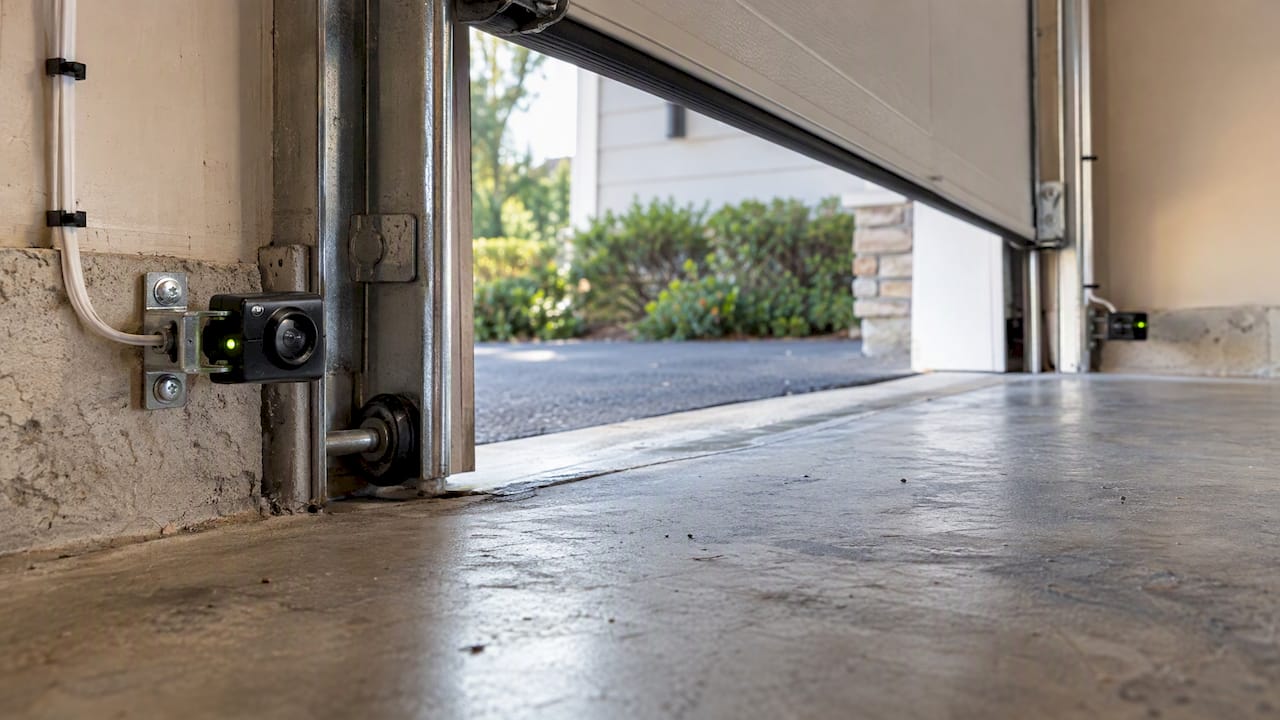
If your opener is acting up after an impact, our opener repair and installation service covers diagnosing and fixing it.
What to do if you manage property or sell homes
Landlords, property managers, agents and business owners usually need more than a cosmetic fix. A dented door in a rental, a listing or a loading bay is a liability question as much as an appearance question.
Ask for a system-level inspection and written repair-versus-replacement options. DASMA’s guidance for technicians says the owner should be presented with the viable options after the visual and operational assessment. For a property file, that means a record of panel condition, track alignment, hardware, cables, springs, opener safety and any framing damage.
That gives owners and occupants a clear basis for deciding, and it avoids a quick patch on a door that needs more.
Why costs vary, and how to get a useful estimate
Dent repair does not have a single price, and we do not give a number without seeing the door. The main variables are:
- Door material, thickness and finish
- The size, depth and location of the dent
- Whether the panel is creased, cracked or separating
- Whether tracks, hinges, rollers, cables or springs also need work
- Whether a matching replacement section is available
- Whether the opener needs adjustment or repair after the impact
The fastest way to a realistic estimate is to send or have ready the photos you took, along with the door’s approximate size and age, and a note about how it is operating. We give a clear estimate before beginning repairs. Call (719) 257-3379 to request one.
Our perspective: look at the whole door
Most people call us about the dent. What we think about first is everything attached to it.
A garage door is a balanced system. The panels, hinges, rollers, tracks, cables and springs all depend on each other. When a car bumps a section or hail pounds an older steel door, the panel gets the attention because it is the part you see. But the problems that hurt people and cost more later are usually out of sight: a hinge that has loosened, a cable that has shifted, a spring that is now carrying a door that no longer sits true.
So our approach is to inspect first, explain what we find in plain terms, and give you a clear estimate before we start. Sometimes that means a straightforward repair. Sometimes it means a replacement panel. And sometimes it means telling you that a new door is the better answer, because one repair on top of several worn parts is not good value. We would rather tell you that than patch a door we would not trust.
We also hold a firm line on springs and cables. They operate under high tension, and they are not a place for homeowners to experiment, however many videos make it look easy. If your dented door is stuck, crooked or has a broken spring, keep clear and call.
— Sean Smith
Dented door in Colorado Springs? Call us
Pro Spring Garage Door is a locally owned company serving homeowners, property managers and businesses in Colorado Springs, Fountain, Monument, Falcon, Woodland Park, Manitou Springs, Pueblo and the surrounding communities. We handle garage door repair, spring replacement, opener work and new door installation, and we use quality replacement parts. You can read more about our parts and technicians.
Call (719) 257-3379 to schedule service or request an estimate. For emergencies, we are available 24/7, and same-day appointments depend on availability.
FAQ
Can a dented garage door be fixed?
Often, yes. Repair is realistic when the damage is limited to a panel and the tracks, hinges, rollers, framing and springs are still serviceable. If the panel is buckled, cracked or separated, or the hardware is damaged, a technician may recommend replacing the panel or the whole door.
How much does it cost to fix a dent on a garage door?
It varies with the door material, the size and location of the dent, and whether other parts are damaged. We do not quote a figure without seeing the door. Call us at (719) 257-3379 and we will give you a personalized estimate before any work begins.
Can I pop the dent out myself?
We do not recommend it. Panels are thin, and pushing or hammering can stretch the metal or crack the finish. More importantly, the panel is tied into a system of cables and springs under high tension, and a hidden hinge or roller problem is easy to miss. Have a trained technician look at it.
Is it safe to keep using a dented door?
Not if it is rubbing, crooked, stuck or noisy in a new way. Do not force it with the opener. Stop using it, keep people and vehicles clear, and have it inspected. If a spring or cable is also damaged, call for emergency service.
Should I replace the panel or the whole door?
It depends on how many sections are damaged, whether a matching panel is available, and how worn the rest of the door is. An older door with several problems often makes a new door the more sensible choice. A technician can lay out both options after an inspection.
Sources
- DASMA: Building Occupant, Checking a Garage Door for Damage
- DASMA: Trained Door Systems Technician, Checking a Garage Door for Damage
- DASMA: Residential Sectional Garage Door and Electric Operator Checklist
- DASMA: Ask Joe Hetzel on adding struts
- DASMA: Garage Door Systems safety tips
- CPSC: Non-Reversing Automatic Garage Door Openers Are a Hazard
Made with BabyLoveGrowth to create better content
This article is provided for general informational purposes only. Garage door springs, cables, and other components can be dangerous to repair without proper training and equipment. For professional garage door repairs, contact Pro Spring Garage Door at (719) 257-3379. We provide 24/7 emergency garage door services throughout Colorado Springs and surrounding communities.