
When your garage door won’t open, the cause is usually one of three things: the opener has no power or signal, a safety sensor or lock is blocking it, or a spring or cable has failed. The first two you can often sort out in a few minutes. The third is a job for a professional, because those parts hold a lot of tension. This guide walks you through the checks that are safe to do, the signs that mean you should stop, and what to expect when you call.
If you’re in Colorado Springs, Monument, Fountain, Security-Widefield, Falcon, Peyton, Castle Rock or a nearby community and you suspect a broken spring or cable, call Pro Spring Garage Door at (719) 257-3379. We offer 24/7 emergency garage door service, and same-day appointments are available subject to availability.
TL;DR
- Start with the simple checks: power, wall button, remote batteries, the lock on the door, and the safety sensors.
- If the motor hums or runs but the door doesn’t move, or the door only lifts a few inches, suspect a spring, cable or track problem.
- Never try to adjust, remove or replace springs, cables or the brackets that hold them. Those parts are under high tension.
- A door that is crooked, off its tracks or visibly damaged should not be run again until a technician has looked at it.
- For urgent problems, call (719) 257-3379 for 24/7 emergency service in Colorado Springs and surrounding areas.
Table of Contents
- Start with what the door is doing
- Quick checks that are safe to do yourself
- When the opener runs but the door doesn’t move
- Door only opens a few inches
- Signs of a broken spring
- Signs of a damaged or snapped cable
- Why you should leave springs and cables alone
- Using the emergency release the right way
- Stuck closed after a storm or cold snap
- What about the opener itself?
- When to call a professional
- What happens when you call us
- Our perspective: fix the cause, not just the symptom
- Get your door moving again
- FAQ
- Sources
Start with what the door is doing
Before you touch anything, pay attention to the symptom. It narrows the cause quickly and tells you whether you’re in DIY territory or not.
| What you see or hear | Most likely cause | Safe for you to check? |
|---|---|---|
| Nothing happens, no click, no light | Power, tripped breaker, unplugged opener | Yes |
| Wall button works, remote doesn’t | Remote batteries or signal | Yes |
| Opener clicks or lights flash but door stays put | Lock engaged, sensor problem, opener safety lockout | Yes, with limits |
| Motor runs or hums, door doesn’t lift | Broken spring, snapped cable, disconnected trolley | Look only |
| Door lifts a few inches, then stops or drops | Broken spring, cable problem, or binding track | Look only |
| Door is crooked, one side higher | Cable or roller problem, bent track | Look only |
| Loud bang, then door won’t move | Spring most likely broke | Look only, then call |
“Look only” means exactly that. Don’t touch the springs, cables, or the bracket at the bottom corners of the door.
Quick checks that are safe to do yourself
These cost nothing and fix a surprising share of stuck doors. Work through them in order.
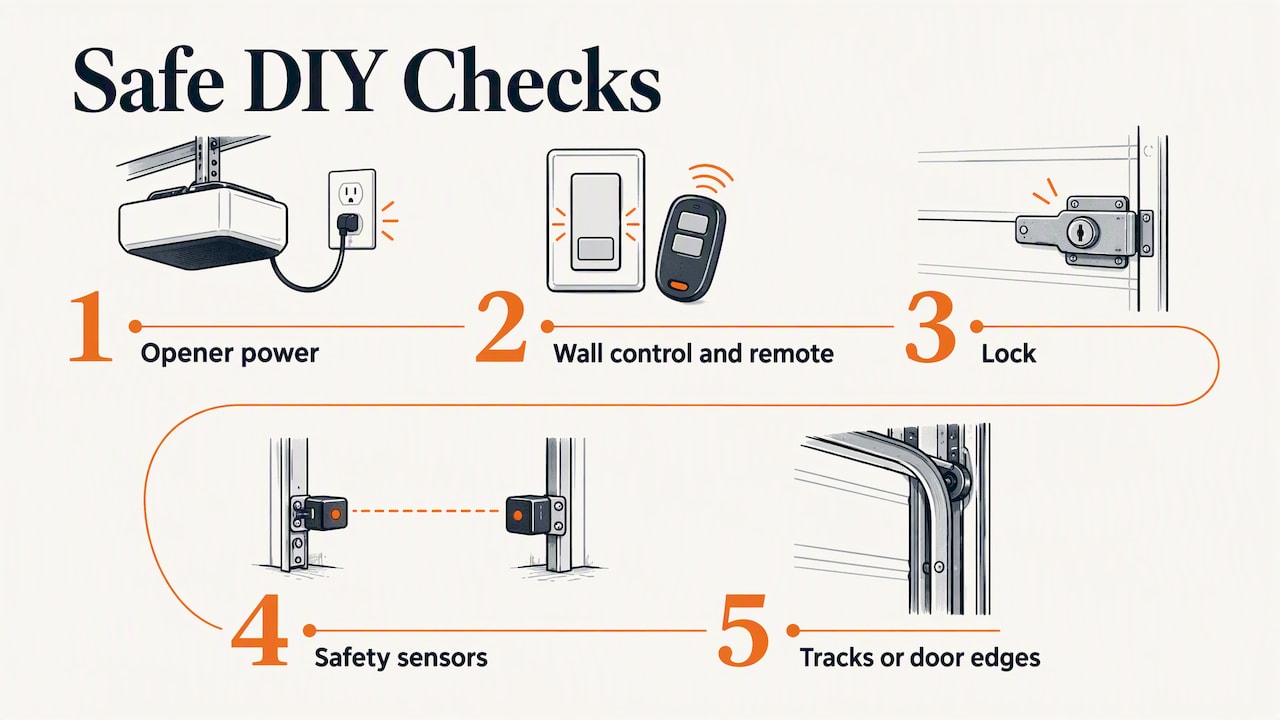
1. Power
Confirm the opener is plugged in, usually into an outlet on the ceiling near the motor. Check the breaker panel for a tripped circuit. If the light on the opener is off, the unit isn’t getting power. Garage outlets are often tied to a GFCI outlet elsewhere in the garage, so press the reset button on any nearby GFCI outlet too. If the breaker trips again right away, stop and have the wiring or opener looked at.
2. The wall button and the remote
Try the wall control first. If it works and the remote doesn’t, replace the remote batteries. If neither works but the opener has power, the control may need to be reprogrammed or replaced. A keypad that has stopped responding often just needs new batteries too.
3. The lock
Many wall controls have a “lock” or “vacation” button that tells the opener to ignore the remote. If the wall unit is blinking or the remote does nothing, look at that button. Some doors also have a manual slide lock on the door itself. If it’s engaged, the opener will strain against it and the door won’t open. Never force it. Disengage the lock and try again.
4. The safety sensors
Two small eyes sit near the floor on each side of the door. They mostly matter when the door is closing, since the safety sensors must be connected and aligned before the opener will move the door down. But a blocked or misaligned sensor can also make an opener behave strangely, with blinking lights or a door that won’t respond normally. Wipe each lens with a soft cloth, clear away cobwebs or anything stored in front of them, and check that both indicator lights are steady. If a sensor has been bumped, gently aim it back so the lights come on.
5. The tracks and the door edges
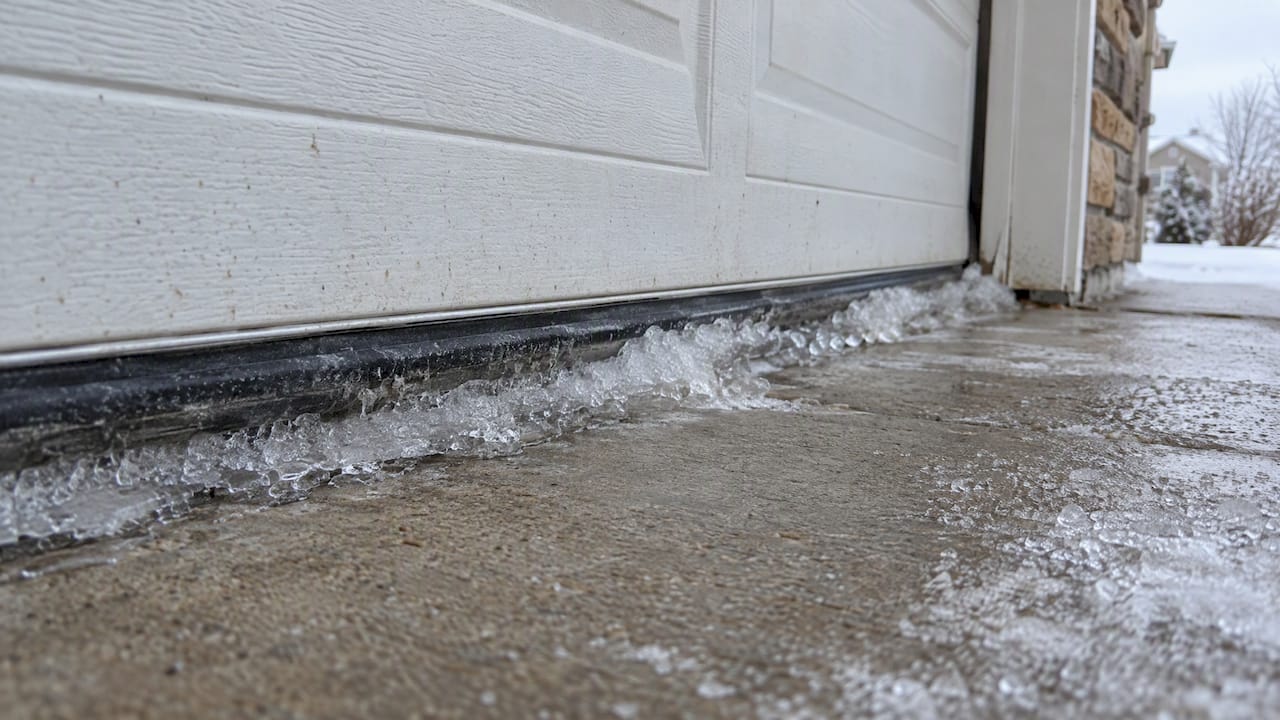
With the door closed, look along the vertical tracks. A stored box, a bike handle, a pile of snow or ice at the bottom, or debris can block the path. Colorado winters make this common: ice melts, refreezes and can glue the bottom seal to the slab. Clear what you can reach without touching any springs or cables. If a track looks bent or a roller has popped out, that’s a repair, not a tweak.
When the opener runs but the door doesn’t move
This is the symptom people search for as “opener hums but won’t open,” and it matters because it usually points away from the opener itself.
The opener is built to guide the door, not to carry its full weight. The springs do the lifting. When a spring breaks, the opener is suddenly asked to lift the entire door by itself. It often hums, strains, or lifts for an inch or two and quits. Some openers are also designed to stop when they detect that kind of load.
Other causes of a humming opener with no movement:
- The trolley is disconnected. If someone pulled the red emergency release cord, the carriage that connects the opener to the door is detached. The motor runs, the carriage slides, the door stays still.
- A stripped gear or drive part. Older openers can wear out internal gears. You may hear grinding and see the chain or belt barely move.
- A loose chain or belt. The trolley stops pulling because the drive has slipped.
To tell these apart without touching dangerous parts, watch the carriage on the rail while someone presses the button. If the carriage travels but the door doesn’t, the door may be disconnected or too heavy to lift, which points toward a spring. If the carriage doesn’t move at all, the problem is more likely inside the opener. In either case, our opener repair and installation service covers diagnosis and repair, and we can tell you whether the opener or the door is the real problem.
Door only opens a few inches
A door that cracks open just a little and then stops or drops is one of the clearest warning signs of a mechanical issue. Common causes:
- A broken torsion or extension spring. The door is far heavier than the opener can manage alone.
- A snapped or slipped lift cable. One side may hang lower, and the door may look tilted.
- A track obstruction or bent track. A roller jams and the opener’s safety logic stops the door.
- Opener force or travel limits set wrong. This can happen after a power surge or reset, but it is a setting problem only once the door is mechanically sound.
A quick balance test is sometimes recommended online: disconnect the opener and lift the door by hand. We don’t recommend it unless you can first see that the springs and cables look intact, and even then it isn’t something to try on a door that is crooked, noisy, or has failed suddenly. If something gives while you’re lifting, the full weight of the door can come down. If you have any doubt, leave it closed and call.
Signs of a broken spring
Most residential doors use one or two torsion springs mounted on a bar above the door, or extension springs along the sides. They store enough energy to counterbalance a door that weighs hundreds of pounds, and they wear out after a set number of cycles.
Signs a spring has broken:
- A loud bang from the garage, often described as a gunshot sound, sometimes heard from inside the house.
- A visible gap in the coil of the torsion spring above the door.
- The door feels extremely heavy if you try to lift it by hand, or won’t lift at all.
- The opener strains, hums, or only raises the door a few inches.
- A door that rises unevenly, or slams down when released.
If you see any of these, don’t operate the door repeatedly. Repeated attempts can damage the opener, bend the door, or pull a cable off its drum. Our page on a broken garage door spring and what to do right now explains the next steps in more detail, and our spring replacement service is how we get you moving again.
Signs of a damaged or snapped cable
Lift cables run from the bottom corner brackets up to the drums or pulleys. Each one carries a major share of the door’s weight. A cable can fray, slip off its drum or snap, and when that happens the door often hangs crooked or jams in the tracks.
Watch for:
- One side of the door sitting lower than the other.
- A cable that hangs loose, is bunched up near the drum, or is visibly frayed.
- The door jamming partway up.
- A scraping or slapping sound as the door moves.
A cable problem can also come with a spring problem, since both parts age together. Read our guide to what to do when a garage door cable breaks for what we see in homes around Colorado Springs.
Why you should leave springs and cables alone
This is the part where we’re blunt. Garage door springs and cables operate under high tension, and the bottom bracket that holds a cable is under load even when the door is closed. A slipped tool or a wrong turn can release that energy in an instant. Federal safety rules for openers reflect how seriously this is taken: the instruction warnings required in manuals say that a qualified service person should repair cables, spring assemblies and other hardware rather than the homeowner. A U.S. Department of Energy safety bulletin on roll-up doors makes a similar point in a workplace setting: failed doors can cause serious harm because of their weight, and a rule of thumb for inspection is that looking is fine and touching is not.
So here is our line:
- Do not loosen, tighten, unwind, or remove a spring.
- Do not unbolt or reattach a cable or the bottom bracket.
- Do not stand under a door that isn’t fully closed and that you believe has a failed part.
- Do not buy a spring online and install it yourself.
The repair itself requires the right winding bars, the right spring size for your specific door, and a way to balance the door afterward. Getting the size wrong leaves a door that slams or won’t stay open.
Using the emergency release the right way
If your garage door won’t open and your car is stuck inside, the red release cord hanging from the trolley can help in some situations. Pulling it disconnects the door from the opener so that the door can be moved by hand.
Use it only when you’re confident the problem is the opener or power, not a spring or cable. That means:
- The door is closed and looks level.
- You heard no loud bang and see no gap in the spring or loose cable.
- The door is not stuck partway open.
If all of that holds, pull the cord and try lifting the door gently. If it’s very heavy or won’t stay up, let it back down slowly and stop. That’s a sign of a counterbalance failure. Also don’t pull the release while the door is up and you suspect a spring problem, because an unbalanced door can drop fast.
Later, to reconnect, the carriage generally re-engages when the opener next runs, but follow your opener’s manual.
Stuck closed after a storm or cold snap
Around Colorado Springs, Monument and Falcon, a door that was fine yesterday can refuse to move after a freeze. The usual culprits are ice under the bottom seal, stiff or hardened lubricant on rollers and hinges, and cold weather making an already weak spring or worn opener struggle. If you see ice, you can carefully clear it from the floor and the seal. Don’t pry the door loose. If the door moves but groans, that’s often an early warning that parts are tired. It’s a good time to schedule a check before a failure happens at 6 a.m. on a work day.
What about the opener itself?
Sometimes the problem really is the opener. Signs include no response with good power, a motor that clicks once and quits, a burned smell, a remote that works only from very close, or a door that starts to move and reverses. Older openers also may lack modern safety features. The U.S. Consumer Product Safety Commission says homeowners with openers that don’t reverse automatically should repair or replace them with new reversing openers, because of the risk to children. If your opener is old, noisy and unreliable, replacement may make more sense than another repair. We can help you weigh that. See our opener repair and installation page, or if the whole door is worn out, our new garage door installation service.
When to call a professional
Call right away if:
- You heard a bang and the door has not worked since.
- You can see a gap in a spring, or a cable is loose or frayed.
- The door is crooked, off its tracks, or has bent panels or tracks.
- The opener hums but the door will not move.
- The door opens only a few inches.
- You’ve tried the basic checks and nothing changed.
- The door is stuck partway open and you can’t safely close it.
For a door with visible damage, broader garage door repair may be needed, covering tracks, rollers, hinges and panels. A dented panel can also keep a door from tracking properly, and our guide on dent repair or panel replacement can help you decide.
What happens when you call us
When you call Pro Spring Garage Door, we ask what the door is doing, what you’ve already checked and whether anything is stuck or damaged. A technician comes to your property, inspects the springs, cables, tracks, rollers and opener, and gives you a clear estimate before beginning repairs. Costs vary depending on what has failed and what the door needs, so we don’t quote numbers in an article. We give you one for your door. We use quality replacement parts and professional workmanship, and we serve homeowners, property managers, landlords, real estate agents and businesses.
Our perspective: fix the cause, not just the symptom
Most calls we get start with the same sentence: “My garage door won’t open.” What we see behind that sentence varies, but a few patterns repeat. Springs wear out because they’re rated for a limited number of cycles, and a door used several times a day wears them faster. Cables fray from the same load. When one part fails, others are often close behind, so we look at the whole system and not just the part you noticed.
We also see people make the problem worse before calling. They keep pressing the button on a door with a broken spring, which strains the opener. Or they try to lift a door that has dropped a cable. We’d much rather you leave it closed, stay clear and call us, even at night. That’s why we offer 24/7 emergency service, with same-day appointments when our schedule allows.
Finally, we’re a locally owned company, so we know the area: winter ice in Monument, dry wind and dust in Falcon and Peyton, older homes in Fountain and Security-Widefield, and newer builds in Castle Rock. Each shapes how doors wear. Regular maintenance catches loose hardware and worn rollers before they turn into a stuck door.
— Sean Smith
Get your door moving again
If your garage door won’t open and the quick checks haven’t solved it, don’t keep fighting it. Pro Spring Garage Door provides emergency garage door service day and night, plus scheduled repairs, spring replacement, opener service and new door installation across Colorado Springs and nearby communities. Call (719) 257-3379 to describe the problem and request an estimate, or see our garage door repair page to learn more. Same-day appointments are subject to availability.
FAQ
Why won’t my garage door open even though the motor is running?
The opener is working, but something between the motor and the door is not. The most common causes are a broken spring, a snapped cable, or a disconnected trolley after the release cord was pulled. Don’t keep pressing the button, since that strains the opener. Call a professional to inspect the door.
Why does my garage door only open a few inches?
Usually the door is too heavy for the opener because a spring has broken or a cable has slipped. A blocked or bent track can also stop it. Stay clear of the door and don’t try to force it up. A technician can find the exact cause safely.
Can I open a stuck garage door manually?
Only if the problem is power or the opener and the door looks level with no sign of a broken spring or cable. Pull the red release cord and lift slowly. If the door is very heavy, crooked, or won’t stay up, stop and call for service.
Is a garage door that won’t open an emergency?
It can be. If your car is trapped, the home is unsecured because the door is stuck open, or you suspect a broken spring or cable, call us. We offer 24/7 emergency garage door service in Colorado Springs and surrounding areas, with same-day appointments subject to availability.
Why does my garage door not respond to the remote?
Start with the remote batteries and the lock button on the wall control. Check that the opener has power and that the sensors are clean and lit. If those all look fine, the remote may need reprogramming, or the opener’s receiver may be failing.
Sources
- 16 CFR 1211.16, Instruction manual (eCFR)
- Non-Reversing Automatic Garage Door Openers Are a Hazard (U.S. CPSC)
- Safety Concern: Roll-up Doors (U.S. Department of Energy)
- Safety Reversing Sensor Replacement Kit 041A5034 (Chamberlain)
This article is provided for general informational purposes only. Garage door springs, cables, and other components can be dangerous to repair without proper training and equipment. For professional garage door repairs, contact Pro Spring Garage Door at (719) 257-3379. We provide 24/7 emergency garage door services throughout Colorado Springs and surrounding communities.