
Most of the time, a garage door that won’t close is being stopped on purpose. The opener’s safety system sees something it doesn’t like, such as a blocked or crooked sensor, an obstruction in the track, or a travel limit that is set wrong, and it refuses to bring the door down. Many of these problems take five minutes to check. A few, especially anything involving springs or cables, are not safe for a homeowner to touch. This guide covers both, so you know what to try and where to stop.
If your door is stuck open or half open and you can’t secure your home, or you heard a loud bang right before it stopped working, call us now at (719) 257-3379. We offer 24/7 emergency garage door service in Colorado Springs and nearby communities, with same-day appointments subject to availability.
TL;DR
- Start with the sensors near the floor on each side of the door. Wipe the lenses, clear anything in the way, and check that both indicator lights are steady.
- If the door closes a few inches and goes back up, the opener thinks something is in the way. If it stops short of the floor, look at the tracks, the rollers and the opener’s travel limit.
- Check the remote batteries, the wall control’s lock setting and the power supply before you suspect the opener itself.
- Never adjust, remove or replace springs or cables. They are under high tension and can cause serious injury.
- Broken parts, a heavy door, or a door that falls or shifts crooked is a job for a professional. We’re available 24/7 for emergencies at (719) 257-3379.
Table of Contents
- What your door is doing tells you where to look
- Five quick checks before anything else
- Safety sensors: the most common culprit
- Why the door closes, then goes back up
- Why the door won’t close all the way
- Remotes, wall controls and the opener itself
- Test the safety reversal once a month
- What you should never touch
- Our perspective: what we see on service calls
- When to call a professional
- Service when you need it
- FAQ
- Sources
What your door is doing tells you where to look
Before you start poking around, watch what the door does when you press the button. The behavior narrows the cause quickly.
| What you see | Most likely cause | Who should handle it |
|---|---|---|
| Nothing happens at all | Dead remote batteries, no power, locked wall control | You, for the simple checks |
| Door starts down, then goes back up | Sensor problem, obstruction, or force setting | You for sensors; a pro if it keeps happening |
| Door stops a few inches above the floor | Travel limit set wrong, debris at the floor | You for debris; a pro for limit settings if the manual doesn’t help |
| Door jerks, shakes or looks crooked | Bent track, worn rollers, a loose or damaged cable | A professional |
| Opener hums or clicks but the door doesn’t move | Disconnected trolley, spring problem, or opener failure | A professional |
| Door feels very heavy when lifted by hand | Broken or worn spring | A professional, right away |
The rest of this article follows that table, from the easiest checks to the ones that need a technician.
Five quick checks before anything else
These take a few minutes and need no tools. They also rule out the causes that account for a lot of service calls that didn’t need to happen.
- Look for anything in the door’s path. A rake, a bag of salt, a child’s bike or a wedge of snow and ice can stop the door or trip the sensors. Clear the area under the door and along both tracks.
- Check the remote. Replace the batteries if you haven’t in a while. Then try the wall button. If the wall button works and the remote doesn’t, the problem is the remote or its programming, not the door.
- Look at the wall control. Many wall panels have a lock or vacation setting that tells the opener to ignore remotes. If your panel has a lock button, make sure it is off.
- Confirm the opener has power. Check that it is plugged in, that the outlet works (plug in a lamp), and that a breaker or GFCI outlet hasn’t tripped. Garage outlets are often on a GFCI that trips in cold or damp weather.
- Watch the sensor lights. We cover this next, because it solves more cases than anything else on the list.
Safety sensors: the most common culprit
Every modern opener has a pair of photoelectric sensors, small units mounted on either side of the door close to the floor. One sends an invisible beam and the other receives it. If anything breaks the beam, the door will not close, or it will reverse. Federal rules require this kind of protection on residential openers; the federal safety standard for garage door operators covers entrapment protection, and the CPSC says these sensors should sit 4 to 6 inches above the floor.
That low position is exactly why they cause so many problems. They get bumped by bins and bikes, covered in dust, or knocked out of line by a lawn mower.
How to check them
- Read the lights. Each sensor has a small indicator light. Colors vary by brand, so check your opener’s manual, but in general a steady light on both units means they are aligned and talking to each other. A blinking or dark light on one unit usually means misalignment, a loose wire or a blocked lens.
- Wipe the lenses. Use a soft, dry or slightly damp cloth. Cobwebs, dust and low winter sun glare can all interfere.
- Check the angle. The two sensors must face each other directly. If one has been nudged, gently turn it back until its light goes steady. Most are held by a wing nut or bracket.
- Follow the wire. Look along the thin wires running up the wall toward the opener for a staple that has pulled loose, a pinched section or a chewed spot. Rodents sometimes chew them.
- Look for sun interference. If the door closes fine in the evening but fails in the morning or afternoon, direct sunlight on the receiving sensor may be the cause. Shading the lens with a short piece of cardboard tube can confirm it.
If you get both lights steady and the door closes normally, you’ve fixed it. If one light stays dark after you’ve cleaned and aligned both units, the sensor or its wire may have failed. That is a quick repair for a technician, and it is worth doing promptly, because you should never bypass a sensor.
Why the door closes, then goes back up
This is one of the most common complaints, and it has a few separate causes.
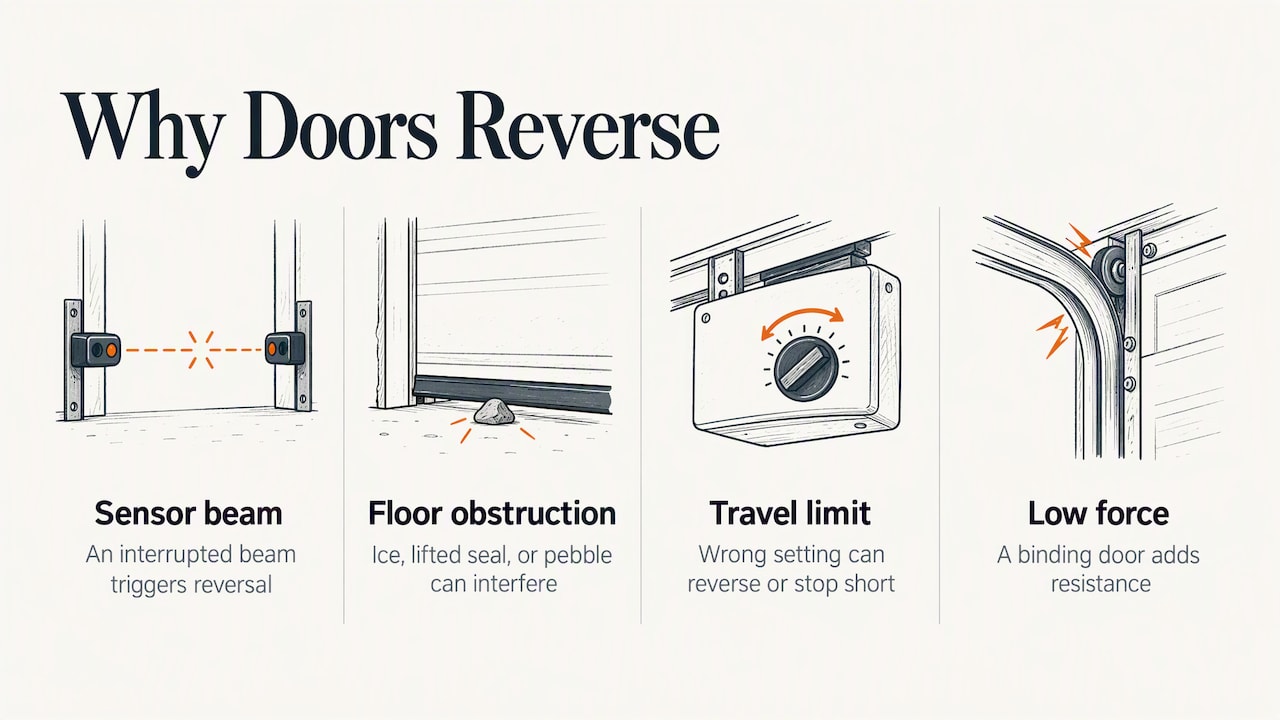
Sensors. If the beam is interrupted while the door is travelling down, the opener reverses. A misaligned sensor often does this after the door has moved partway.
The door hits something. When the door touches the floor or an object, the opener senses resistance and reverses for safety. Check for ice, a lifted seal, a pebble or a warped section of concrete where the door lands.
Travel limit is set wrong. The opener has a limit setting that tells it how far down to go. If the limit is set too far, the opener thinks the door has hit an obstacle and reverses. If it is set too short, the door stops before it seals. Your opener’s manual explains how to change the setting for your model, and it is worth following exactly. Industry guidance on garage door safety standards stresses following the manufacturer’s instructions when adjusting force settings or limits, so the door stays compliant with entrapment protection. If the manual doesn’t resolve it, stop and call a technician.
Force setting is too low. If the door is hard to move because of a track or balance problem, the opener sees extra resistance and reverses. Turning the force up can hide the real issue and put strain on the opener. The CPSC notes that a door that binds or doesn’t move smoothly can lead to early opener failure, and that is a sign to have the mechanical side inspected rather than to crank up the settings.
Why the door won’t close all the way
If the door stops short or leaves a gap at the bottom, look at these in order.
Debris and the floor
A buildup of leaves, gravel or ice under the door is the easy one. Clear the threshold and look at the bottom seal. A torn or twisted rubber seal can catch and stop the door.
Tracks and rollers
The tracks guide the rollers on each side of the door. You can safely do a visual check with the door fully closed or fully open and the opener unplugged:
- Look for dents, kinks or gaps where a track has been hit by a car or bin.
- Look for tracks that have pulled away from the wall.
- Check for rollers that are chipped, flat, or wobbling in the track.
- Wipe out dirt and old grease. A light spray of garage door lubricant on the rollers and hinges helps; do not grease the tracks themselves with heavy grease.
Do not loosen the bolts on the track brackets or try to bend a track back by hand. Track brackets sit near the cable system, and a door that is out of alignment can come off the track and fall. Damaged rollers and bent tracks need a technician to fix correctly. Our garage door repair service covers tracks, rollers, hinges and panels for homes and businesses.
The opener’s travel limits
Limits tell the opener where “fully open” and “fully closed” are. They can drift after a power surge, a loose trolley or a change in temperature, and they are often reset when a door has been serviced. See the section above: follow the manual, and if the limits don’t hold, the opener’s circuit board or gear may be wearing out.
A door that is out of balance
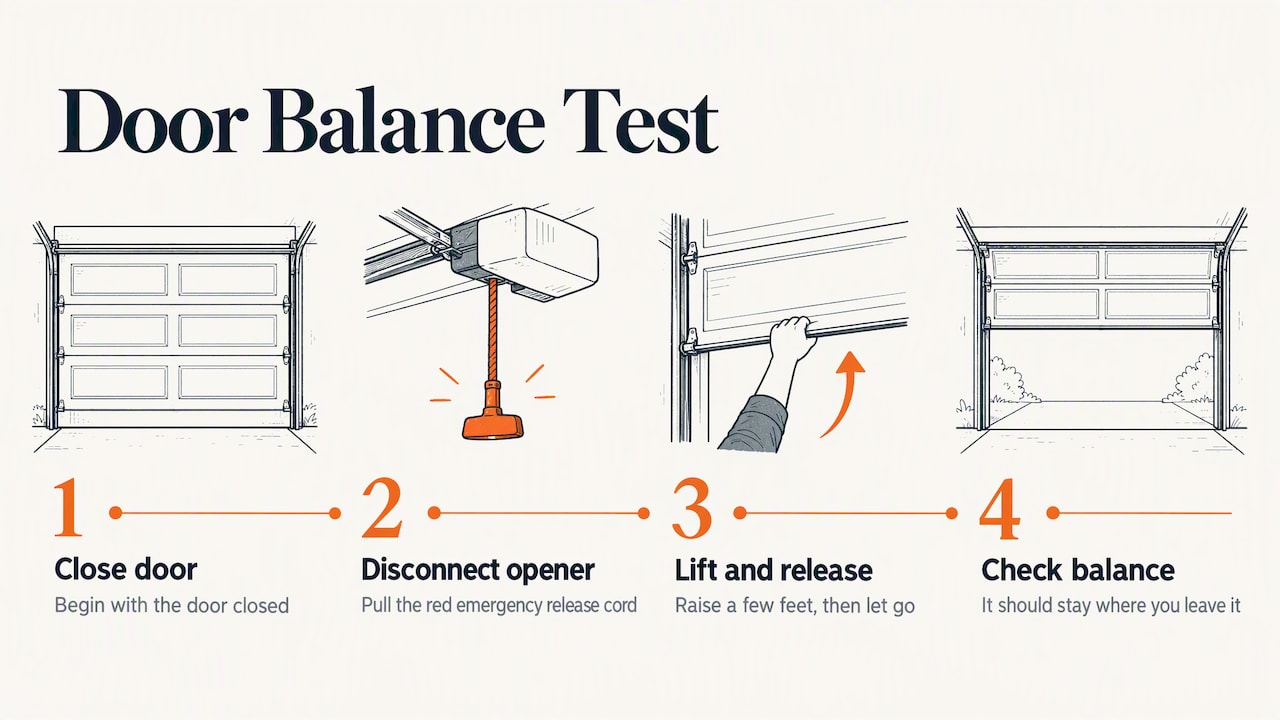
Here is a test that tells you a lot without touching anything dangerous. With the door closed, pull the red emergency release cord to disconnect the door from the opener. Then lift the door by hand a few feet and let go. A properly balanced door should stay where you leave it. The CPSC says a balanced door holds in place when stopped partway, and if yours drifts down or feels very heavy, the counterbalance system, which includes the springs, is likely worn or broken.
If the door fails this test, stop. Don’t keep running it with the opener. An unbalanced door strains the opener and can come down hard. Call a professional for spring replacement.
Remotes, wall controls and the opener itself
If the door never starts moving, the cause is often in the signal chain, not the door.
- Reprogram the remote. Remotes can lose their pairing after a power outage or battery change. Your opener has a learn button, usually on the back of the motor unit. The manual shows the steps for your model.
- Try the wall control. If it works but the remote doesn’t, the remote is the problem. If neither works, look at power and the opener.
- Reset the opener. Unplugging the unit for about 30 seconds and plugging it back in clears many glitches. If it is hard-wired, switch off the breaker instead.
- Listen. If the motor runs but the door doesn’t move, the trolley may have disengaged from the carriage. Re-engaging is sometimes as simple as pulling the release cord and running the opener, but only attempt this if the door is fully closed and balanced. If the door is open or the mechanism looks damaged, leave it.
- Consider the age. Openers wear out. If yours is old, noisy and unreliable, repair costs may start to add up compared with replacement. We can assess both options with you. See our opener repair and installation page.
Test the safety reversal once a month
Once the door is closing again, confirm that the safety reversal still works. The CPSC recommends laying a 2×4 flat on the floor in the door’s path and running the door down. The door should reverse when it touches the board. If it doesn’t, the CPSC advises disconnecting the opener and calling a professional right away for repair or replacement. An opener that keeps closing against an obstruction is a danger to children, pets and property, and the federal rules exist for that reason.
What you should never touch
Some parts of a garage door are not DIY territory, however many videos you’ve seen.
- Torsion and extension springs. They hold the full weight of the door in stored tension.
- Lift cables. They are attached to the bottom brackets and are under the same load.
- Bottom brackets and drums. Loosening these while the system is tensioned can release it suddenly.
The CPSC warns that these components can cause severe injuries or death if they release, and says adjustment or replacement belongs to trained technicians with the right tools. Signs of trouble include a loud bang from the garage, a visible gap in the spring, frayed or slack cable, a door that sits crooked, or a door that is suddenly very heavy. If you see any of these, keep people and cars away from the door and call us. We explain what to do in our guides on a broken garage door spring and on a broken garage door cable.
Our perspective: what we see on service calls
We get calls every week from Colorado Springs homeowners who say the opener is broken. In many of them, the opener is fine. A sensor has been knocked, a track is dirty or a remote is out of batteries. That is good news, and we’ll tell you over the phone if a quick check might save you a visit.
The calls we worry about are the ones where the homeowner has already tried to “tighten” something on a spring or loosen a cable bracket. Our rule is simple: if the fix involves a part under tension, it isn’t a home project. A door can weigh well over a hundred pounds, and the parts that lift it don’t give warning when they let go.
We also see a pattern after cold snaps. Metal contracts, grease thickens, ice forms under the seal, and a door that was borderline in September starts misbehaving in November. If your door has been slow or noisy, it’s cheaper and safer to have it looked at before it fails on a freezing morning. When we do an assessment, we give you a clear estimate before we start work, and since costs depend on the parts and the repair, we quote for your specific door.
— Sean Smith
When to call a professional
Call a technician if any of these apply:
- The door is off its track, bent, or hanging crooked.
- A spring is visibly broken or you heard a loud bang.
- A cable is frayed, loose or off its drum.
- The door is heavy or falls when disconnected from the opener.
- The door reverses or won’t close even after the sensors are clean and aligned.
- The opener runs without moving the door, or burns out after a few cycles.
- The safety reversal test with the 2×4 fails.
- You can’t safely secure the garage overnight.
Our garage door repair team handles these for homes, rental properties and businesses. If your door is past repair, or you’ve been patching it for years, ask us about a new garage door installation.
Service when you need it
Pro Spring Garage Door is a locally owned company serving Colorado Springs and nearby communities, including Monument, Fountain, Falcon, Peyton, Security-Widefield and Castle Rock. We offer 24/7 emergency garage door service, and same-day appointments are available depending on our schedule that day. We replace springs and cables, repair and install openers, fix tracks and rollers, and install new doors.
Pricing varies with the problem, the parts and your door, so we don’t publish numbers. Call us at (719) 257-3379 and we’ll give you a clear estimate before any repair begins. Property managers and landlords are welcome to call for tenants’ doors, and we also serve commercial customers.
FAQ
Why won’t my garage door close when nothing is in the way?
The sensors may be dirty, slightly misaligned or have a loose wire, even when nothing seems to block them. Wipe both lenses and check that each light is steady. If the lights are fine, the cause may be the travel limit, the force setting or a track problem, and a technician can test these.
How do I reset a garage door sensor?
There is rarely a reset button. You realign the two sensors so they face each other, clean the lenses and confirm that both lights are steady. If that doesn’t help, unplug the opener for about 30 seconds and plug it back in. If one sensor light stays dark, the sensor or its wire needs replacing.
Why does my garage door go back up when I close it?
The opener believes something is in the way. That might be a blocked sensor, contact with the floor, or a force or travel limit setting that is off. Check the sensors and the floor first. If it keeps happening, have it inspected, because a door that binds can also be a balance problem.
Can I close my garage door manually?
Yes, in many cases. Pull the red release cord with the door fully closed or fully open, then move it by hand. If it is very heavy or won’t stay put, a spring is likely failing, so don’t force it. Call a professional, and don’t leave the garage unsecured. For emergencies, we’re available 24/7.
Is a door that won’t close an emergency?
It can be. If the door is stuck open and you can’t secure your home, or a spring or cable has broken, call right away. Call us at (719) 257-3379 for emergency service in Colorado Springs and surrounding areas, with same-day appointments subject to availability.
Sources
- CPSC: Non-Reversing Automatic Garage Door Openers Are a Hazard
- eCFR: 16 CFR Part 1211, Safety Standard for Automatic Residential Garage Door Operators
- ICC Building Safety Journal: Garage door provisions in the International Residential Code
This article is provided for general informational purposes only. Garage door springs, cables, and other components can be dangerous to repair without proper training and equipment. For professional garage door repairs, contact Pro Spring Garage Door at (719) 257-3379. We provide 24/7 emergency garage door services throughout Colorado Springs and surrounding communities.