
An insulated garage door has layers of steel with foam between them. The foam slows heat moving through the door, so the garage stays closer to a comfortable temperature, runs quieter, and the door resists dents better. It pays off most when the garage is attached to your house or used as a workshop, gym, or hobby space. It matters less if the garage only holds a car and the door opens many times a day. This guide covers how insulated doors are built, how to read an R-value, and how to decide whether one fits your home in Colorado Springs or the surrounding area.
TL;DR
- Insulated doors slow heat transfer. They do not heat or cool your garage, so walls, ceiling, and air leaks still decide the final temperature.
- Polyurethane foam generally gives a higher R-value than polystyrene, but a tight seal around the door matters as much as the number.
- The upgrade is most useful for attached garages and garages used as living or work space. It is less useful for a car-only garage with a door that opens constantly.
- Cost depends on size, style, insulation type, hardware, and installation, so a personal estimate is the only reliable number. Call us at (719) 257-3379.
- Springs, cables, and tracks on any door are under high tension. Leave them to a trained technician.
Table of Contents
- What an insulated garage door actually is
- Polyurethane or polystyrene: the material matters
- Understanding R-value without the confusion
- Insulated vs. non-insulated: how they compare
- Do insulated doors keep a garage cooler or warmer?
- The real benefits, ranked by how much they matter
- When an insulated door is not worth it
- What affects the price of an insulated door
- Match the opener and hardware to the heavier door
- Perspective: what we see on Colorado Springs doors
- Signs it may be time to replace rather than repair
- Choosing the right door: a short checklist
- Insulated garage doors across our service area
- Ready for an insulated door? Talk to us
- FAQ
- Sources
What an insulated garage door actually is
A basic non-insulated door is a single layer of steel or aluminum. It keeps out rain and people, but heat passes through it almost freely, so the garage tracks the outdoor temperature closely. An insulated door has two or more layers with polystyrene or polyurethane foam between them. That foam acts as a thermal barrier. It also stiffens the panel, which is why insulated doors tend to be quieter and shrug off minor impacts better.
You will usually see three constructions:
- Single layer, no insulation. Steel only. Lightest and simplest.
- Two layers. A steel exterior with insulation attached to the back, sometimes covered by a thin backing.
- Three layers. Steel outside, insulation in the middle, and steel on the inside. This is the sturdiest and usually the most thermally effective.
To check what you have now, look at the inside of a panel. A bare, ribbed steel surface with nothing behind it means no insulation. A flat or textured inner skin, or visible foam, means some insulation is present. Panels that feel noticeably heavier and sound solid when you knock on them are usually insulated.
Polyurethane or polystyrene: the material matters
The two common foams behave differently. Polyurethane has higher R-values and strength than polystyrene. In many doors, polyurethane is foamed in place, expanding between the steel layers and bonding to the door, while polystyrene is typically installed as rigid panels. That bond is one reason foamed-in doors feel more rigid.
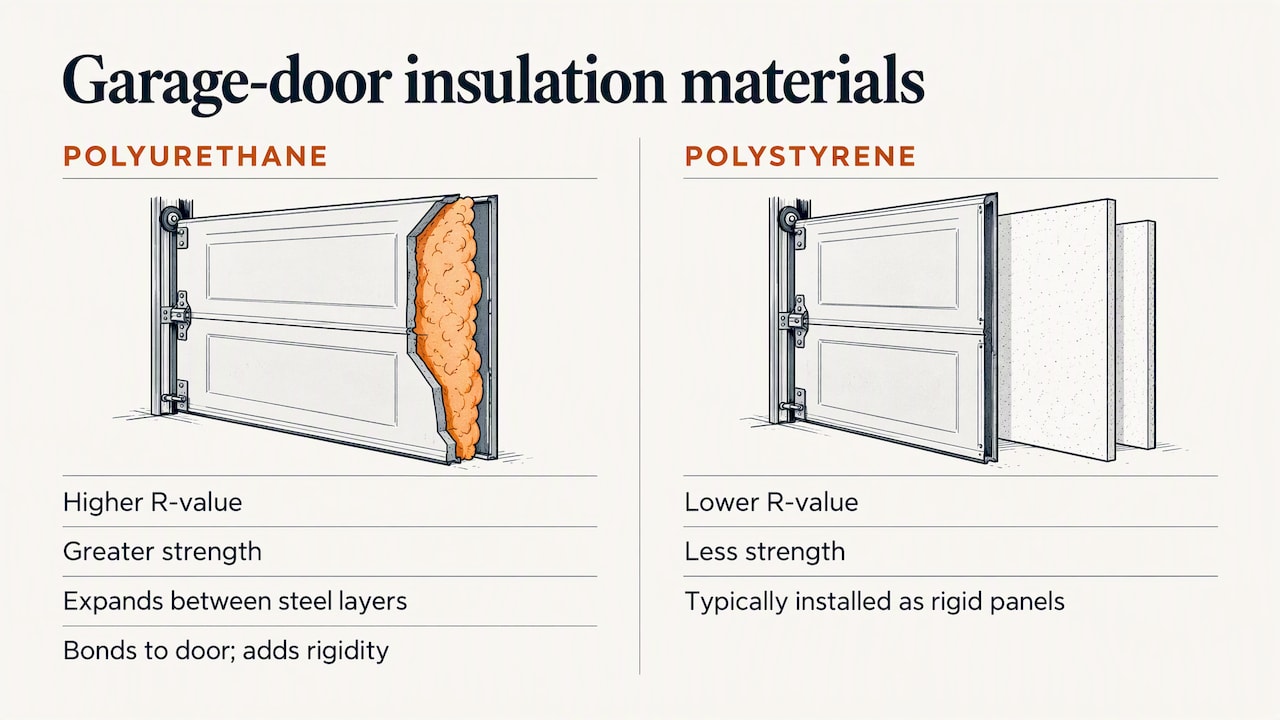
Polystyrene doors still do real work. They are a reasonable step up from bare steel, and for a garage that is not heated or cooled they may be all you need. If you want the best thermal performance and sturdiness, polyurethane is the stronger choice.
Understanding R-value without the confusion
R-value measures resistance to heat flow. A higher R-value means greater resistance. A non-insulated door is close to zero. Insulated doors range widely. As one example, a popular steel model line with foamed-in-place polyurethane is rated R-9 on 7-foot doors and R-10 on 8-foot doors, while some premium polyurethane models are listed at R-values up to 20.4.
Two cautions before you chase the biggest number:
- The rating describes the door section, not your installed door. The same manufacturer notes that actual thermal performance may vary by size and configuration. Gaps at the edges and bottom are not captured in a section rating.
- Sealing beats raw R-value. One building-industry guide puts it plainly: a tight, well-sealed door with modest R-value will almost always outperform a poorly sealed door with high R-value.
That is why weatherstripping at the bottom, sides, and top is part of the decision, not an afterthought. An insulated door with a worn bottom seal still leaks air.
Insulated vs. non-insulated: how they compare
| Feature | Non-insulated | Insulated |
|---|---|---|
| Construction | Single layer of steel or aluminum | Two or three layers with foam core |
| Heat resistance | R-value near zero | Higher R-value, varies by model |
| Garage temperature | Follows outdoor conditions closely | Stays in a narrower range |
| Noise | Louder, rattles more | Quieter operation |
| Dent resistance | Lower | Better |
| Weight | Lighter | Heavier, which affects spring and opener setup |
| Best for | Detached, unheated storage garages | Attached garages, workshops, gyms, living space |
The weight row is worth a note. A heavier door needs springs matched to it, and an opener sized to lift it smoothly. If you swap a non-insulated door for an insulated one, the spring setup has to be checked and often changed. That is work for a trained technician, not a weekend project.
Do insulated doors keep a garage cooler or warmer?
They help, within limits. Insulation slows heat transfer, and the U.S. Department of Energy notes that insulating and weatherizing a home helps keep it cool in summer and warm in winter, with attics and garages especially susceptible to heat transfer. An insulated door cuts down how quickly afternoon sun on the door heats the garage, and how fast cold air pulls heat out in winter.
What it does not do is create heat or cooling. Total garage temperature still depends heavily on walls, roof, ventilation, and air leakage. If your garage has an uninsulated ceiling, a bare shared wall, and gaps around the service door, the garage door is only one of several leaks.
Manufacturer guidance says an insulated door keeps garage temperatures within a narrower range than outdoor temperatures, which especially benefits attached garages and garages used as workshops, gyms, or entertainment spaces. That matches what we would expect: the more time you spend in the space, and the more it connects to your living areas, the more you notice the difference.
The real benefits, ranked by how much they matter
Comfort in a used garage. If you work on projects, lift weights, or run a home office out there, a steadier temperature makes the space more usable through Colorado’s seasonal swings.
Less heat exchange with the house. ENERGY STAR guidance says sealing an attached garage from conditioned living areas is important for energy and health, because the garage can be a major source of heat gain and heat loss. A better door helps, but the wall and door between the garage and house matter too.
Quieter operation. Foam-filled panels dampen vibration. If a bedroom sits over the garage, this can be the benefit you notice first. A quieter opener and well-maintained rollers add to it.
Dent resistance. Layered panels hold up better to bumped basketballs and stray bikes than a single thin skin. For the dents that still happen, see our guide on garage door dent repair and when to replace a panel.
Vehicle and stored items. Insulated doors can limit the effects of extreme temperatures on car batteries and reduce noise. The same source says they may raise appraisal value by as much as 4 percent, a figure we would treat as an upper bound, since it depends on the home and market.
When an insulated door is not worth it
Being honest here saves you money. Insulating may be a waste if the garage is mainly used for storage or parking and the door opens several times a day. In that case insulating the ceiling or shared walls may reduce energy loss more effectively. Another home-improvement outlet makes a similar point: insulating the walls and ceilings that connect to the home can have a bigger effect on energy bills than door insulation alone.
The Department of Energy’s Building America guide adds a useful order of operations: air sealing and insulation work together, and insulation money can be wasted if holes and gaps in ceilings, walls, and foundations are not sealed first. If your garage has obvious gaps, fix those, then upgrade the door.
A simple way to decide:
- Is the garage attached to the house? If yes, an insulated door has more to offer.
- Do you spend real time in it? Workshop, gym, or studio use raises the value.
- Is the garage heated or cooled? The effect is more noticeable when the garage is heated, cooled, or frequently used.
- Is the current door worn out anyway? Replacing a failing door with an insulated one costs less in total than replacing it twice.
- Is the door mostly a car portal? Then prioritize sealing and the ceiling first.
What affects the price of an insulated door
We do not publish prices in articles, because the honest answer is that a job’s cost depends on several things that differ house to house. The main ones:
- Door size. Single-car, double-car, and oversized or tall doors are different projects.
- Insulation type and construction. Polystyrene and polyurethane, and two-layer versus three-layer panels, sit at different levels.
- Style and finish. Flat or raised panels, carriage-house looks, colors, and windows.
- Hardware. Springs sized for the door’s weight, tracks, rollers, and a bottom seal.
- Opener. A heavier door may call for a different opener or adjustments to the existing one.
- Installation conditions. Existing framing, headroom, and whether old parts need replacing.
The quickest route to an accurate number is a conversation about your door opening and how you use the garage. Call (719) 257-3379 and we will give you a clear estimate before any work begins.
Match the opener and hardware to the heavier door
Insulated doors weigh more, and the whole system has to work in balance. Springs carry the door’s weight, cables transfer the load, and the opener only guides the door. If the springs are wrong for the weight, the opener strains, the door feels heavy, and parts wear out early.
Garage door springs and cables operate under high tension and can cause serious injury if they release. Do not try to adjust, remove, or replace them yourself. Our spring replacement service covers sizing springs correctly for the door in place, and our opener repair and installation service covers matching an opener to the door’s weight.
One small habit also protects your investment. An insulated door only insulates when it is closed. A smart WiFi garage door controller lets you check from your phone whether the door was left open, which helps keep a heated workshop or gym from losing its warmth overnight.
Perspective: what we see on Colorado Springs doors
We repair and install garage doors across Colorado Springs and nearby communities, so we see how doors age after years of use. Here is how we think about the insulated door question.
First, we ask how you use the garage before we talk about foam. A homeowner with a finished workshop and a bedroom above the garage has different needs than a landlord with a detached storage garage. Recommending the same door to both would not serve either.
Second, we look at the whole opening. A door can be well built and still leak at a worn bottom seal or a bent section. Often the most helpful thing is to fix an off-track door or replace worn parts before suggesting anything bigger. If a door is failing, replacement with an insulated model is a sensible time to upgrade.
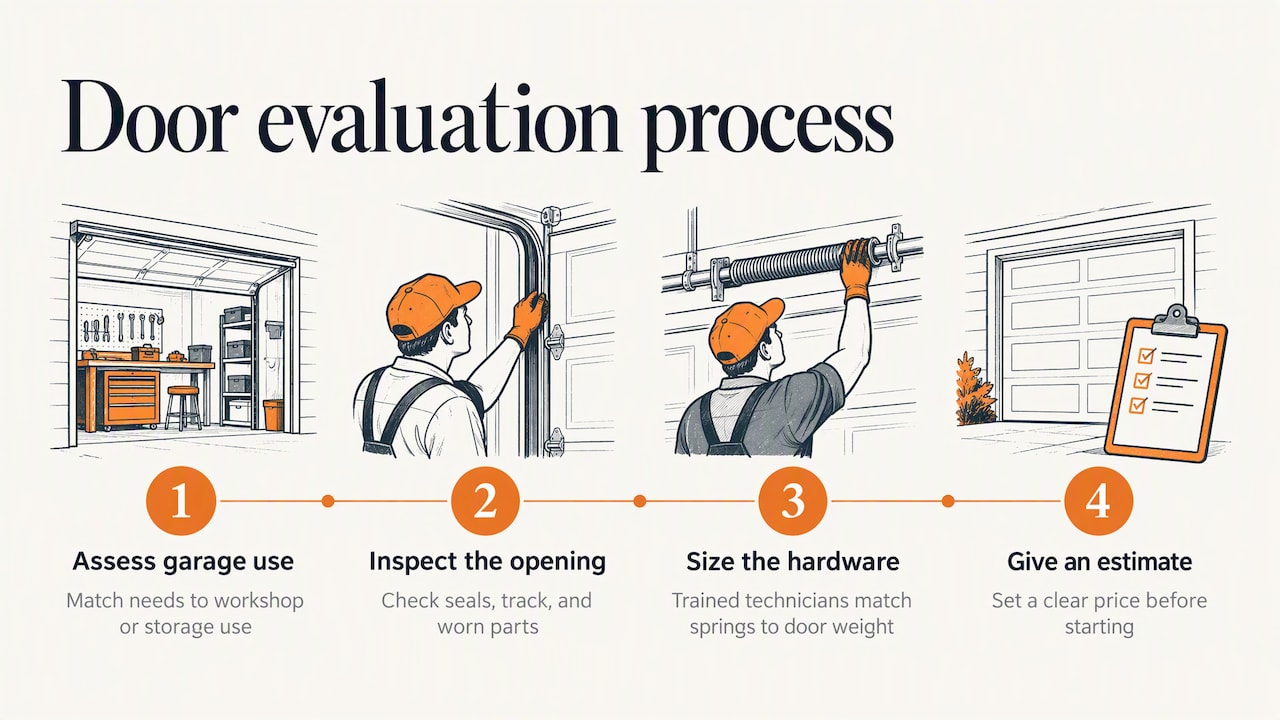
Third, we treat springs and cables as work for trained technicians. A heavier insulated door raises the stakes: the wrong spring is a safety risk and shortens the door’s life. We would rather size it correctly the first time and tell you plainly what the job involves.
Finally, we give a clear estimate before starting. We do not quote numbers from a national chart, because your door, your opening, and your goals decide the price.
— Sean Smith
Signs it may be time to replace rather than repair
Not every door needs replacing, and not every problem justifies it. Consider a new insulated door when several of these apply:
- Sections are cracked, rusted through, or dented beyond what a panel repair can fix.
- The door is single-layer and the garage is uncomfortable in summer or winter.
- Repairs keep recurring: a door that won’t open, won’t close, or keeps coming off track.
- The door is noisy and the opener is working hard to move it.
- You are renovating the garage into living or work space.
If a spring or cable has just failed, the door is not safe to operate. Keep it closed, keep people and vehicles clear, and read what to do about a broken garage door spring or a broken cable. We offer 24/7 emergency garage door service, and same-day appointments are available subject to availability.
Choosing the right door: a short checklist
- Decide how you use the garage. Parking only, storage, or living space.
- Pick the insulation level to match. Polystyrene suits many unheated garages. Polyurethane suits attached or heavily used ones.
- Plan the seals. Ask about the bottom seal and perimeter weatherstripping, since perimeter sealing helps prevent drafts.
- Check the weight and hardware. Springs and opener should suit the finished door.
- Look at the surrounding garage. Ceiling, shared wall, and air gaps may deserve attention first.
- Get a written estimate. Compare scope, not just a total.
Insulated garage doors across our service area
We serve homeowners, property managers, landlords, and businesses in Colorado Springs, Fountain, Monument, Manitou Springs, Woodland Park, Falcon, Pueblo, and nearby communities. Needs vary: a Black Forest home with a detached workshop is a different project from a rental in Cimarron Hills or a commercial bay in Pueblo. Tell us about your property and how the space is used, and we will recommend what makes sense, including leaving the door alone when that is the better answer.
Ready for an insulated door? Talk to us
If you are considering a new door, our new garage door installation service covers selecting, installing, and setting up the door with matching hardware. If your current door needs work first, our garage door repair team can look at what is wrong and tell you whether repair or replacement makes more sense.
Call us at (719) 257-3379 to schedule service or request an estimate. Same-day appointments are subject to availability, and emergency service is available around the clock.
FAQ
Is it worth it to get an insulated garage door?
It depends on how you use the garage. For an attached garage, a workshop, or a gym, the steadier temperature, quieter operation, and sturdier panels are usually worth it. For a car-only garage where the door opens many times a day, sealing the ceiling and shared walls often gives more for the money.
Do insulated garage doors keep the garage cool?
They help by slowing the heat that passes through the door from hot sun and outdoor air. They do not actively cool the space, and the walls, roof, ventilation, and air leaks still shape the final temperature. Think of the door as one part of a whole garage.
What is the difference between an insulated and a non-insulated garage door?
A non-insulated door is a single layer of steel or aluminum with an R-value near zero. An insulated door has two or more layers with foam between them, which resists heat flow, quiets operation, and improves dent resistance. Insulated doors are also heavier, so springs and opener need to match.
How much does an insulated garage door cost?
The cost depends on door size, insulation type, style, hardware, opener needs, and installation conditions, so we do not quote figures in articles. Call (719) 257-3379 and we will give you a clear estimate for your own opening before any work starts.
Can I replace the springs myself when I upgrade to an insulated door?
No. Springs and cables hold high tension and can cause serious injury if mishandled. Because insulated doors are heavier, the springs must be sized correctly, which is work for a trained technician.
Sources
- Insulated vs. non-insulated garage doors
- Insulated garage doors: benefits, options and advice
- Insulated garage door construction and R-values
- Classic steel garage door models and R-values
- Insulating garage doors and sealing
- U.S. Department of Energy: Insulate your home
- Garage door insulation and temperature
- Garage door energy efficiency guidance
- ENERGY STAR guide on sealing attached garages
- Choosing energy-efficient garage doors
- Is insulating a garage door necessary?
- Is insulating a garage door worth it?
- Building America insulation guide
This article is provided for general informational purposes only. Garage door springs, cables, and other components can be dangerous to repair without proper training and equipment. For professional garage door repairs, contact Pro Spring Garage Door at (719) 257-3379. We provide 24/7 emergency garage door services throughout Colorado Springs and surrounding communities.