
If you hit or backed into your garage door, stop, check that everyone is okay, and leave the opener alone until the door has been looked over. A door that is bent, off its track or hanging crooked can get worse every time it moves. Springs and cables also sit under high tension, so the repair belongs with a trained technician. If you are in Colorado Springs or a nearby community, call Pro Spring Garage Door at (719) 257-3379. We offer 24/7 emergency garage door service, and same-day appointments are subject to availability.
TL;DR
- Check for injuries first. Call 911 if anyone is hurt or there is a danger such as fire or debris.
- Stop using the opener and the wall button until the door is inspected. Running a damaged door can turn a small repair into a large one.
- Look at the door from a safe distance. Do not touch the springs, cables or brackets, and do not try to force the door up or down.
- Cost depends on what was damaged: a panel, rollers, a track, the framing, a spring or the opener. A technician needs to see it to give you a real estimate.
- Call us for an on-site estimate. Pro Spring Garage Door serves Colorado Springs and surrounding communities, with 24/7 emergency service.
Table of Contents
- The first few minutes after the impact
- How to check the damage without taking risks
- Springs and cables: leave them alone
- Common damage after a car hits a garage door
- Repair a panel or replace the whole door?
- What the repair will cost
- Does insurance cover a garage door you hit?
- A note from our team
- Get the door checked by Pro Spring Garage Door
- How to avoid hitting the door again
- FAQ
- Sources
The first few minutes after the impact
Before you think about the door, think about people. Check yourself, passengers and anyone nearby, including kids or pets who may have been in the garage. The Maine State Police crash guidance says to dial 911 right away for injuries or dangers such as fire, flying debris or the chance of another crash. A garage door strike at driveway speed is usually minor, but a heavy door, a broken spring or a shifted frame can hurt someone.
If nobody is injured and the car still runs, move it away from the door so nothing else is at risk. The Wisconsin Department of Transportation suggests turning on your hazard lights and moving an operable vehicle to a safer spot only when nobody is hurt. On a driveway that mostly means pulling clear of the door and the street.
Then take these steps:
- Turn off the engine and keep the car out of the door’s path.
- Stop pressing the opener remote and the wall button.
- If the door is partly open and the opener is still running, unplug the opener only if you can do it without standing under the door.
- Keep people and pets out of the garage doorway.
- Take photos of the door, the tracks, the car and the surrounding area before anything is moved. You will want them for an estimate and possibly for an insurance claim.
If the door is stuck half open, it is a safety and security problem, because the house is open to anyone. That is a good reason to call an emergency line instead of waiting for business hours. We answer calls around the clock for urgent garage door problems in Colorado Springs.
How to check the damage without taking risks
The Door and Access Systems Manufacturers Association (DASMA) publishes guidance for building occupants on checking a garage door after damage. It says the inspection is done with the door closed, from a safe position. You look at the alignment, the frame, the tracks, rollers, brackets, hinges, the spring system and the door sections. You watch for cracks, dents, buckling and loose cables, and you do not touch spring-system parts.
Here is what that looks like in practice.
What to look at
- The panels. Dents, creases, cracks or a section that bows out. A single dented panel is a different job from several panels with broken hinges.
- The tracks. Look for bends, gaps or a track that has pulled away from the wall. A track that is no longer straight is the most common reason a door jams.
- The rollers and hinges. Rollers popped out of the track, or hinges that are cracked or twisted, show that the door has shifted.
- The cables. Loose, frayed or hanging cables mean tension has been lost somewhere. Our guide to a broken garage door cable explains what that means and what to do.
- The springs. Look for a visible gap in the coil or a spring that has shifted. Look only. Do not touch.
- The frame around the door. Check the jambs and the header for cracks, splits or fasteners that have pulled loose.
The frame deserves attention. DASMA’s technician guidance says that when the condition of the surrounding framing or its attachment to the structure is uncertain, a building contractor or design professional should assess it. A door cannot be repaired properly if the wood it is fastened to is damaged.
Why you should not test the door
It is tempting to press the button just to see. Do not do this if you saw any problem during the visual check. DASMA says that if the closed-door inspection shows a problem, you should not go on to operate the door. Its guidance allows cautious testing only after a clear visual inspection. In that case you disconnect the operator and stop at once if the door moves on its own, feels too heavy, binds, sways or looks stressed.
A door that is off its tracks can fall. A door with a damaged panel can fold or twist when the opener pulls on it. The opener itself can strip gears or bend its rail while it tries to lift something that will not move. That is how a repair that might have been one panel and a few rollers becomes a new opener too.
Springs and cables: leave them alone
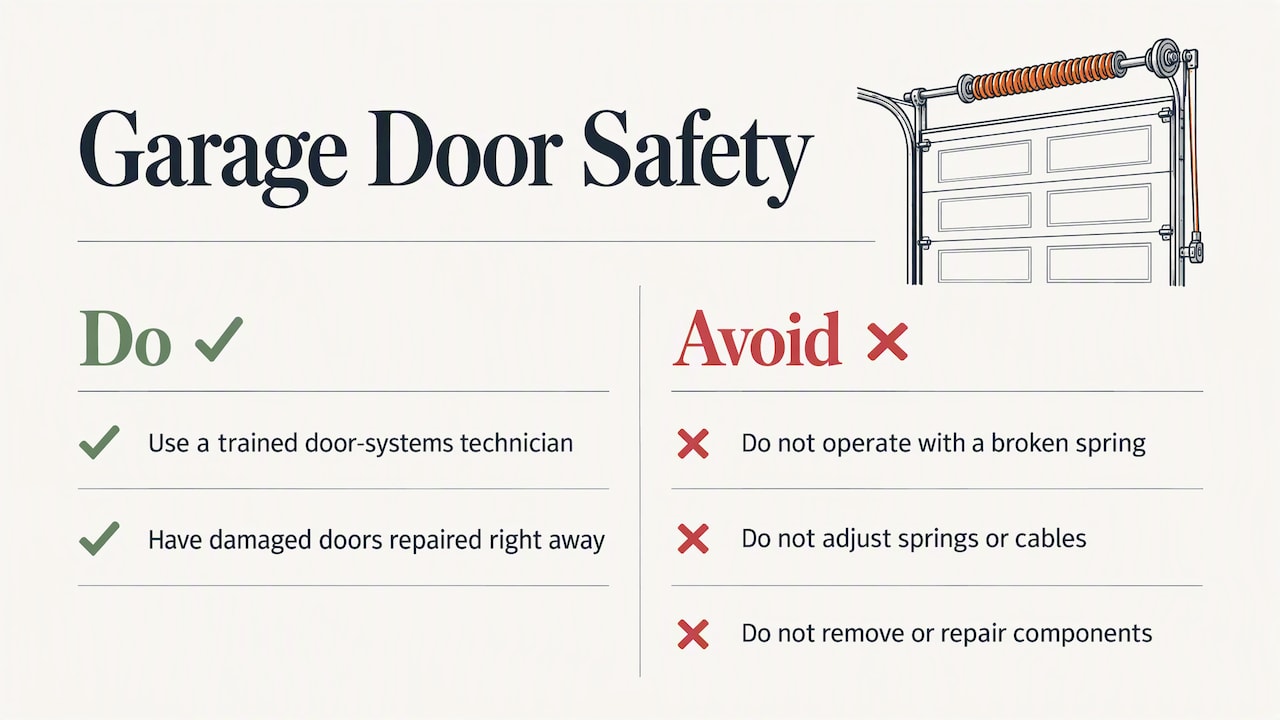
This is the part we want you to remember. The springs and cables on a garage door hold the weight of the door, and they are under very high tension. DASMA’s checklist for consumers says that if a spring is broken, you should not operate the door, and that repairs and adjustments should be done by a trained door-systems technician.
The building occupant guidance is more direct. It says occupants should not remove, adjust or repair a garage door, its springs or attached components, because doors are heavy and springs are under extreme tension, and that kind of work can cause serious injury or death. Door manufacturers say the same. A Wayne Dalton owner’s manual tells owners that a damaged or hard-to-operate door should be repaired right away by a trained door-systems technician, and not to adjust the springs, cables, brackets or supports themselves.
So even if a video makes it look simple, do not try to pry the door back into the track, loosen a bracket or wind a spring. If the car hit the door hard enough to bend a track, the forces in the system have already changed. If you think a spring broke or shifted, our page on a broken garage door spring walks through the signs, and our spring replacement service covers the repair itself.
Common damage after a car hits a garage door
No two impacts are the same, but a few patterns show up again and again in driveways around Colorado Springs, Fountain, Monument and Pueblo West.
Backing out with the door not fully up
This is the classic. The door is partway open, the car clips the bottom or the lower panel, and the panel creases or the bottom section pushes inward. Often the top rollers are fine, but the lower rollers or hinges have been knocked out of place. The door may be crooked or stuck.
Pulling in and clipping the track or jamb
A side-swipe against the door jamb or the vertical track bends the track and can pull the bracket out of the wall. The door may still move but it will rub, shake or stop. This is where the framing check matters most.
Hitting the door from outside while it is closed
A car that rolls forward into a closed door usually dents or cracks one or two panels. Sometimes the whole door buckles at the middle, and the cables or the top struts get involved. If your issue is mainly a dent, see our guide to garage door dent repair. For splits and holes, see cracked garage door panels.
Door knocked off its track
When rollers jump out of the track, the door hangs unevenly. It looks like a small thing, but it is one of the more dangerous situations because the door is no longer supported the way it was designed to be. Read what to do when the door is off track and keep clear of it until a technician arrives.
Door that now will not move
After a hit, a door that refuses to close or open usually has something bent or a sensor knocked out of alignment, or a broken part. Our pages on a door that won’t close and one that won’t open cover the common causes. If the motor hums but the door stays put, see the motor is running but the door is not opening.
Repair a panel or replace the whole door?
This is the question behind most calls. The honest answer is that it depends on the condition of the whole system, not just the part you can see. DASMA’s technician guidance says that when an inspection finds a problem, the owner should get a repair-or-replace judgment and all the viable options, with attention to the sections, stiles, struts, hinges, rollers and fasteners.
That is how we approach it. A few things push the decision one way or the other:
| What we see | Usually points toward |
|---|---|
| One dented or cracked panel, track and hardware fine | Repairing or replacing that section, if a matching section is available |
| Bent track, popped rollers, damaged hinges, panels intact | Track, roller and hinge repair |
| Several damaged sections or a door that has buckled | Replacing the door |
| Older door where a matching panel is hard to find | Weighing a panel swap against a new door |
| Damaged framing around the opening | Framing repair first, then the door work |
| Door is structurally fine but the opener was strained | Opener inspection or repair |
Matching is a real issue. A replacement section needs to fit your door’s model, size, color and style, and on older doors that is not always possible. Sometimes a mismatched panel looks worse than a new door would. If that is where you land, our new garage door installation page explains what is involved. In Colorado, it is also worth asking about insulated garage doors, because a replacement is a chance to upgrade.
If the impact also strained the opener, we can look at it during the same visit. Our opener repair and installation service covers both repair and replacement, and our guide to LiftMaster openers can help if you decide to replace.
What the repair will cost
We do not publish set prices for this kind of work, and for a good reason: a garage door that was hit could need anything from a few rollers to a full replacement. The cost depends on factors such as:
- how many panels are damaged and whether matching sections are available
- whether the tracks, hinges, rollers or brackets are bent or broken
- whether a spring or cable was damaged
- whether the opener was strained or broken
- whether the framing around the door needs work
- the door’s material, age, insulation and style
- whether you need emergency service outside regular hours
Be wary of any online number that claims to know the price before someone has looked at the door. The way to get a real figure is to have a technician inspect it. We give a clear estimate before we begin repairs, so you know the scope of the work before you decide. Call (719) 257-3379 to request one.
Does insurance cover a garage door you hit?
Sometimes, but it depends on whose property it was and which policy applies. Progressive explains that auto liability generally covers damage a driver causes to someone else’s property, but if you backed into your own garage door, your auto insurance likely will not cover the repair. It suggests checking your homeowners coverage if the loss exceeds your deductible.
Plymouth Rock’s overview lays out the same split. Collision coverage may apply to your car, and homeowners insurance typically covers damage to your own garage door, subject to your policy terms and deductible. Liability coverage is more likely to apply when the door belongs to somebody else, such as a neighbor, a landlord or a rental property.
A practical way to handle it:
- Take photos before anything is moved.
- Get a repair estimate so you know whether the cost is above your deductible. Progressive advises exactly this.
- Call your insurer or agent to confirm what your policy covers before you file.
- Keep the estimate and any invoices.
If you rent, tell your landlord or property manager right away. If you manage rentals, a documented estimate and photos make the claim process smoother. We can provide an estimate for the work, but we can’t tell you what your insurer will cover. That is a question for your agent.
A note from our team
After years of working on garage doors in the Pikes Peak region, what we see most often after a car strike is a homeowner who tried the opener one more time. It makes sense, you want to know if it still works. But a door that is bent or off track is not the same door it was a minute earlier, and the opener is not built to push it through.
Our advice is simple. Leave it closed if you can, take photos, and have it looked at. When we arrive we check the whole system, not only the dent: tracks, rollers, hinges, cables, springs, the opener and the frame. Then we explain the options, repair or replace, and give you a clear estimate before we start.
We also treat springs and cables as work for trained technicians only. They hold the door’s weight under high tension, and a hit can change how they sit. That is why we recommend professional service even when the damage looks minor.
Sean Smith
Get the door checked by Pro Spring Garage Door
Pro Spring Garage Door is a locally owned company serving Colorado Springs and surrounding communities, including Fountain, Manitou Springs, Monument, Woodland Park, Falcon, Pueblo and Pueblo West. We handle garage door repair for homes and commercial properties, from bent tracks and panels to springs, cables and openers, and we offer 24/7 emergency service. Same-day appointments are subject to availability.
Tell us what happened when you call, and send photos if you have them. We will explain what we think is involved, what the options are, and give you a clear estimate before work starts. Call (719) 257-3379 or visit prospringgaragedoor.com.
How to avoid hitting the door again
Most garage door strikes are preventable, and a few habits go a long way.
- Look before you move. Make sure the door is fully up before you start the car, especially when you are rushing in the morning. Many strikes happen when the door is still rising.
- Give the door time. Wait for it to stop moving before you reverse.
- Mind the sides. Narrow garages and large vehicles leave little room. Parking guides or a tennis ball hanging at the right spot can help you stop in the same place each time.
- Keep the remote out of the cup holder. Accidental presses can close or open the door at the wrong moment.
- Have the safety sensors checked. If the door has stopped reversing or closing properly, a technician can look at the opener and sensors.
- Schedule maintenance. A door that is balanced and properly adjusted moves smoothly and is easier to diagnose when something goes wrong.
FAQ
Can I still use my garage door after I hit it?
Not until it has been inspected. If you see dents, bent tracks, loose cables or a door that sits crooked, do not run the opener. DASMA’s guidance says that when the visual check shows a problem, you should stop and contact a trained door-systems technician.
Will the garage door go back up if it hit something?
Sometimes it will, but you should not count on it. Modern openers have safety reversal features, yet those are designed for obstructions in the door’s path, not for a door that is already damaged. If your door is bent or off track, running it can make things worse, so call a technician before using it.
Can I fix a bent track or popped roller myself?
We advise against it. The door is heavy, and the springs and cables that support it are under high tension. DASMA and door manufacturers recommend that a trained technician do repairs and adjustments, and they warn owners not to adjust springs, cables or brackets themselves.
Who pays if I backed into my own garage door?
Usually it is not your auto policy. Progressive says auto insurance likely will not cover repair of your own property, while homeowners coverage may apply if the loss exceeds your deductible. Confirm with your insurer or agent, and get a repair estimate first so you can compare it to your deductible.
Do you offer emergency service if the door is stuck open?
Yes. Pro Spring Garage Door provides 24/7 emergency garage door service in Colorado Springs and surrounding communities. Same-day appointments depend on availability, so call (719) 257-3379 and we will tell you what we can do.
Sources
- Vehicle Crashes FAQ, Maine State Police
- Safe driving, Wisconsin Department of Transportation
- Building Occupant: Checking a Garage Door for Damage, DASMA
- Trained Door Systems Technician: Checking a Garage Door, DASMA
- Residential Sectional Garage Door and Electric Operator Checklist, DASMA
- Wayne Dalton 8100 TorqueMaster owner’s manual
- Does Insurance Cover Car Damage to Property? Progressive
- Does car insurance cover hitting a garage door? Plymouth Rock
This article is provided for general informational purposes only. Garage door springs, cables, and other components can be dangerous to repair without proper training and equipment. For professional garage door repairs, contact Pro Spring Garage Door at (719) 257-3379. We provide 24/7 emergency garage door services throughout Colorado Springs and surrounding communities.