
When the opener runs but the door stays put, the motor is usually fine. The problem is typically somewhere between the motor and the door: a disconnected carriage, a broken chain or belt, a stripped gear, a locked door, or, most often in a door that feels heavy or dead, a broken spring. You can safely check a few of these yourself. The spring and cable side is not one of them. If you’re in Colorado Springs or nearby and the door is stuck shut, call us at (719) 257-3379.
TL;DR
- A running motor does not prove the opener is the problem. The carriage, chain or belt, gears, door lock, or springs can all leave you with a motor that runs and a door that doesn’t move.
- Safe checks: confirm the power source, look at whether the carriage is engaged, make sure the door lock is not set, and watch whether the trolley moves when the opener runs.
- Never adjust, remove, or replace springs, cables, or their hardware yourself. They are under high tension and can cause serious injury.
- If the door feels heavy, won’t lift smoothly by hand, or you heard a loud bang, treat it as a spring problem and stop using the opener.
- We offer 24/7 emergency garage door service across Colorado Springs and surrounding communities. Same-day appointments are subject to availability.
Table of Contents
- What “motor running but door not opening” really tells you
- Start with what you can hear and see
- Safe checks you can make first
- The most likely culprits, one by one
- What not to do
- Perspective: what we see in Colorado Springs garages
- When to call, and what to tell us
- Fast help across Colorado Springs and nearby
- FAQ
- Sources
What “motor running but door not opening” really tells you
The motor, the drive (chain, belt, or screw), the trolley or carriage, and the door itself form a chain of parts. The motor spinning only tells you the first link works. Garaga’s troubleshooting guidance makes the same point: a running opener does not prove the opener failed, because spring failure, binding, an obstruction, or a locked door can all produce a door that doesn’t move or moves only a little.
That is useful, because it splits the problem into two camps:
- Opener-side failures. The motor turns, but the force never reaches the door. Think disengaged carriage, broken chain or belt, stripped drive gear, or a failed screw-drive coupler.
- Door-side failures. The opener is doing its job, but the door is too heavy or too stuck to lift. Think broken spring, a locked door, binding tracks, or a broken cable.
The first camp is often a repair or replacement of an opener part. The second camp can involve the high-tension hardware that you should leave to a trained technician.
Start with what you can hear and see
Before touching anything, pay attention to how the opener behaves. The symptoms point to different causes.
| What you notice | Likely area |
|---|---|
| Motor runs, trolley doesn’t move along the rail | Opener drive: gear, sprocket, chain, belt, or screw |
| Motor runs, trolley moves, door stays down | Carriage disconnected from the door, or a stuck door |
| Opener hums for a second or two, then stops | Often a spring problem or a binding door |
| Door rises a few inches, then stops or reverses | Binding, a lock, a broken spring, or travel settings |
| Loud bang before the problem started | Very likely a broken spring |
| Door sits crooked or one side is lower | Cable or track problem |
The humming and short-travel patterns come from manufacturer guidance. Garaga lists a broken spring as a possible cause when the opener hums for a second or two without moving the door, or the door moves 6 to 8 inches and stops or reverses. Chamberlain’s owner’s manual diagnostic chart says the same short-travel symptom can involve binding, a door lock, or a broken spring, not necessarily a bad motor.
Safe checks you can make first
These checks involve the opener and the door’s outer surface, not the springs or cables. Work through them in order.
1. Confirm the opener has power and the door is not locked
If the opener doesn’t operate at all, check its power source first. In your case the motor does run, so power is probably fine. Still, look at the door itself. A slide lock or deadbolt on the inside of the door, which some people set before a trip, will stop the door while the motor happily runs. Sears PartsDirect also lists making sure the door isn’t locked as an early step.
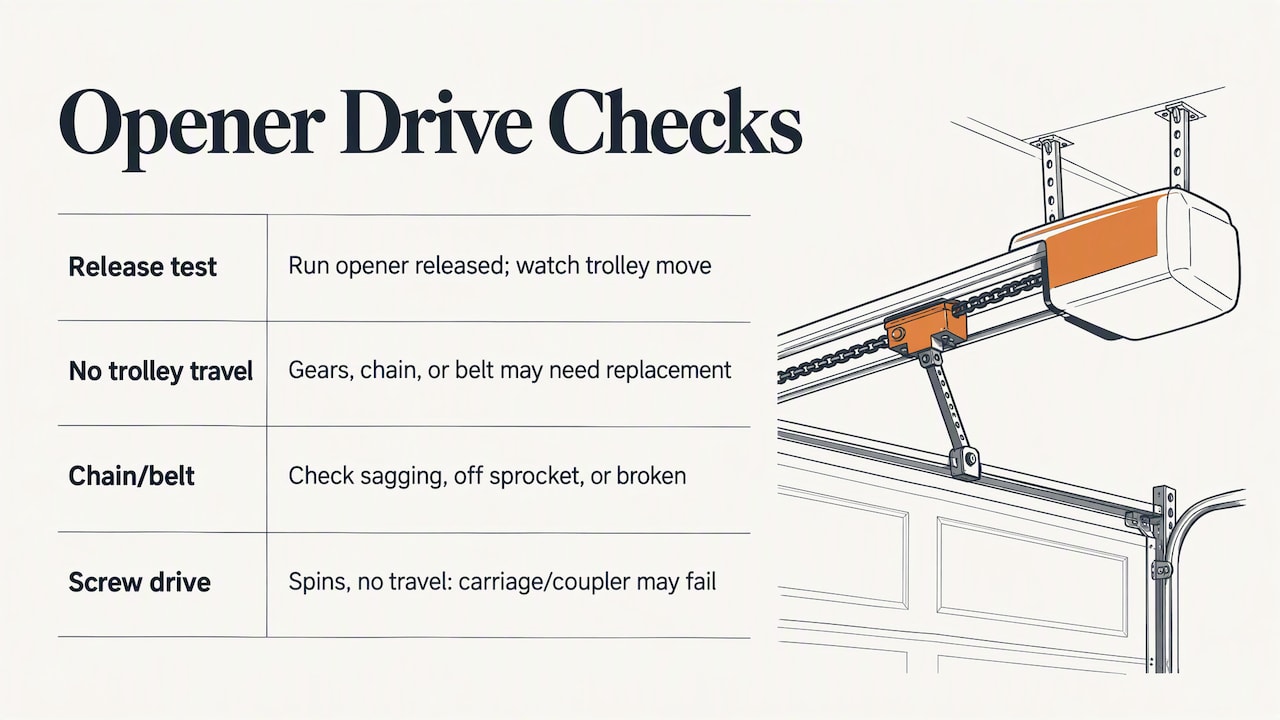
2. Watch the trolley while the opener runs
Look at the rail on the ceiling. When you press the button, does the trolley (the part that slides along the rail) travel? Sears PartsDirect suggests running the opener with the emergency release pulled and observing whether the trolley moves. If the motor runs but the trolley does not move, the gear and sprocket or drive gears may need replacement, and a broken chain or belt can cause the same thing.
On chain or belt models, also look for a chain that is sagging, off its sprocket, or lying in pieces. Genie’s guidance for chain and belt openers says to check whether the carriage is engaged and whether the chain or belt is broken or off its pulley. Overhead Door’s guidance for its openers adds that the carriage should be engaged with the chain or belt.
On a screw-drive opener, see whether the screw rotates. If it spins but nothing travels, the carriage or coupler may have failed.
3. Check whether the carriage is engaged
If someone pulled the red emergency release cord (sometimes accidentally, by a bumped cord or a tall item in a truck bed), the trolley is disconnected from the door. The motor runs, the trolley slides, and the door never knows. Re-engaging the release is the one fix homeowners can often do with the door fully closed. Follow the instructions in your opener’s manual, because the re-engage method differs by brand. Make sure the door is fully closed first. Never re-engage with the door raised.
4. Test the door by hand, carefully
This is the check that tells you which camp you’re in, and it is also the one where people get hurt. Do it only if the door is fully closed.
- Pull the emergency release handle. Amarr’s U.S. owner’s manual says a door with an electric opener must be released with the emergency-release handle before manual operation.
- Lift using the handles or step plate on the door, not the edges or the gaps between panels, where fingers get crushed.
- The door should lift smoothly with little resistance. Amarr says that if it does not, contact a trained garage door technician.
If the door lifts easily and stays up when you release it halfway, the springs are probably doing their job and the problem lies with the opener. If the door feels very heavy, barely moves, or slams back down, stop. That is the sign of a spring that has lost its lifting power, and a door that heavy can drop with force.
The most likely culprits, one by one
A broken torsion spring
The springs counterbalance the door’s weight, so the opener only has to guide it. When a spring breaks, the door becomes dead weight and the opener can’t lift it. The motor hums or runs, the door doesn’t rise, or it rises a few inches and quits.
Signs to look for:
- A loud bang from the garage, often described as a gunshot sound
- A visible gap in the spring above the door, on a torsion system
- A door that feels extremely heavy in manual mode
- An opener that strains, hums, or stops after a short rise
- A door that is crooked or has slack cables
The repair involves winding and securing a spring under high tension. We do not suggest, and the manufacturer manuals do not allow, a do-it-yourself approach. Amarr warns homeowners not to remove, repair, or adjust springs, red-colored fasteners, cables, or their attached hardware because those parts are under high tension. For what to do right now, see our guide to a broken garage door spring, and for the repair itself, our spring replacement service.
A broken or off-track cable
Cables carry the door’s weight alongside the springs. When one snaps or slips off its drum, the door can hang crooked, bind in the tracks, or refuse to rise. Cables are under the same kind of tension as springs. If you see a frayed, dangling, or loose cable, don’t touch it. Our page on a broken garage door cable covers what to do, and if the door has jumped its tracks, read what to do when a garage door is off track.
A disconnected carriage or trolley
Common, cheap to resolve, and easy to miss. If the release cord was pulled, the opener runs without lifting. Reconnecting it typically takes seconds with the door closed. If the trolley keeps popping off, the release mechanism may be worn and worth having looked at.
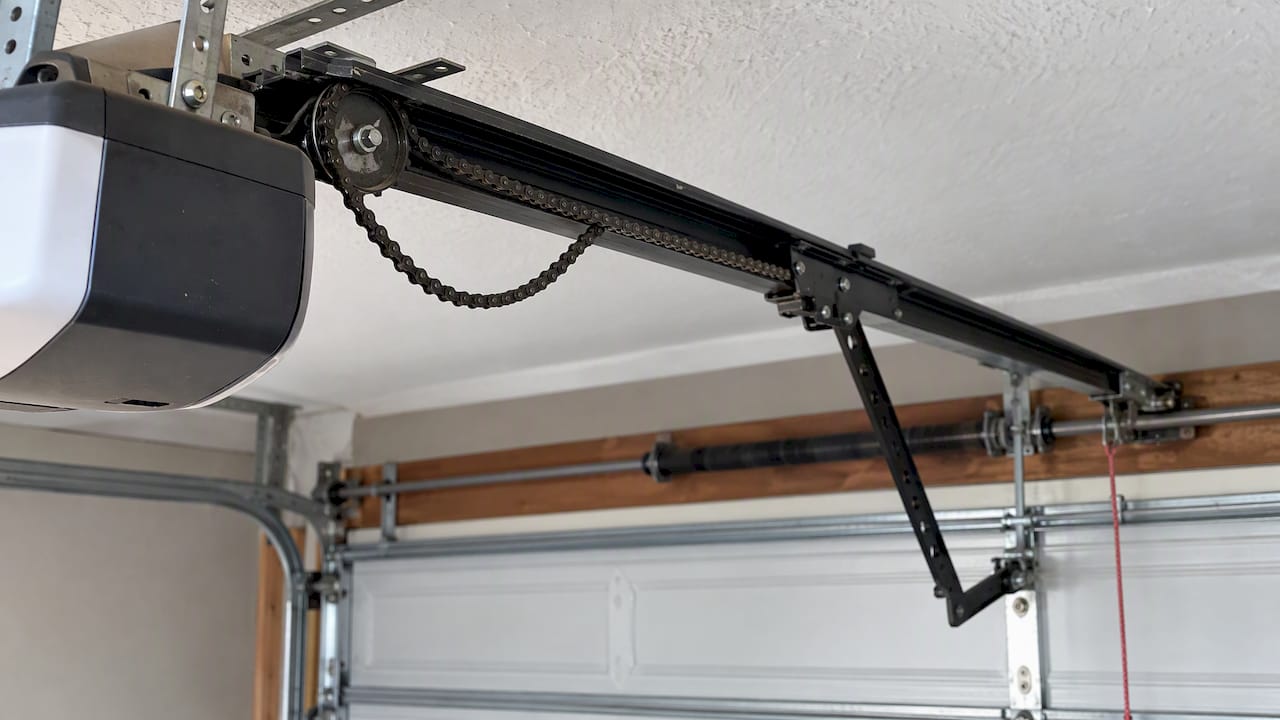
A broken chain or belt
Chains stretch and can jump a sprocket. Belts can crack or shear. Either way, the motor spins freely and nothing pulls the trolley. Look along the rail for a slack, drooping, or broken run. This is an opener repair, and a technician can match the replacement to your model.
A stripped drive gear or failed coupler
Inside the motor housing, a plastic or nylon gear can strip over the years. You’ll hear the motor spin with a grinding or whirring sound while the trolley sits still. The Sears PartsDirect guide ties a running motor with a still trolley to drive gear or sprocket replacement. On a screw drive, Genie points to the carriage or coupler as the part to check.
A locked door or binding tracks
Garaga names binding, obstructions, and an engaged door lock as alternative causes when the opener runs but the door doesn’t move. Look for a bent track, a rolled-out roller, or something wedged in the track. Sears PartsDirect says that if the door moves smoothly by hand, an up-force adjustment may be involved. That is an opener setting a technician can check.
What not to do
- Don’t keep pressing the button. Repeatedly running an opener against a door it can’t lift wears the gears and can strip them, turning one repair into two.
- Don’t try to lift a heavy door by hand. A door without working springs can weigh enough to injure you or crush a vehicle if it drops.
- Don’t touch the springs, cables, or the red-colored fasteners. They hold stored energy.
- Don’t pry or force a door that seems stuck. You may bend the panels or tracks.
- Don’t leave the door open and unattended if you managed to raise it. Without working springs it can fall. Prop it only if you know it is safe, or call for help.
Overhead Door’s guidance draws the same line: homeowners may look at basic conditions, but if a door hardware or spring problem is suspected, call a local garage door professional and don’t repair it yourself.
Perspective: what we see in Colorado Springs garages
When a customer says the motor runs but the door won’t go up, we’ve learned to ask three questions before anything else: Did you hear a bang? Does the door feel heavy by hand? Is the trolley moving? Those answers usually separate a spring problem from an opener problem before a technician even arrives.
The mistake we’d most like to help people avoid is assuming a new opener will fix a door that won’t lift. If the springs are worn out, a new motor doesn’t solve anything, and it puts extra strain on the new unit. Check the door first. If the door is healthy and the opener is the culprit, then repair or replacement of the opener makes sense.
The other thing we’d say plainly: springs and cables are not a weekend project. They store a lot of energy, and the manufacturers’ own manuals tell owners to leave them alone. Calling a pro for these is not upselling, it’s the safe path. We give a clear estimate before we start repairs, and costs depend on the door, the parts, and the work needed, so we don’t quote a number sight unseen.
— Sean Smith
When to call, and what to tell us
Call a professional when any of the following is true:
- You heard a loud bang, or you can see a gap in the spring
- The door is heavy, crooked, or won’t lift smoothly by hand
- You see a frayed or slack cable
- The door moves only a few inches and stops or reverses, and the lock and tracks are clear
- The trolley doesn’t move, and you don’t want to take apart the opener
- You can’t get the car out and need to leave
When you call, mention what you heard and what the trolley does, whether the door lifts by hand, and what brand your opener is. That helps us bring the right parts.
Fast help across Colorado Springs and nearby
A stuck garage door usually happens at the worst time: before work, with a car trapped inside, or at night. We offer 24/7 emergency garage door service in Colorado Springs and in surrounding communities including Fountain, Monument, Falcon, Manitou Springs, Woodland Park, Pueblo, and Pueblo West. Same-day appointments are available based on schedule, so call early.
What we do depends on the diagnosis:
- Broken spring or cable: spring replacement and general garage door repair
- Chain, belt, gear, or carriage failures: opener repair and installation
- A door too worn to keep patching: new garage door installation
Costs vary with the service, the parts, and your door, so we give you a personalized estimate before work begins. Call (719) 257-3379 to describe the problem and request one.

If your door is stuck and you’re not sure why, a short call is often enough to tell whether it sounds like a spring, a cable, or the opener. For a wider look at doors that won’t budge, see our guide on what to do when a garage door won’t open. If the opposite is your trouble, our page on a garage door that won’t close covers it.
FAQ
Can a broken spring make the motor run but the door not open?
Yes. The springs do most of the lifting, so with a broken one the opener is trying to raise the full weight of the door. It may hum, strain, or lift a few inches and stop. Garaga lists a broken spring among the causes of this exact symptom. Don’t test it repeatedly, and call a technician.
Why won’t my garage door open manually either?
First make sure the door is fully closed and the emergency release is pulled, then check the lock. If it still won’t lift smoothly, the cause may be a broken spring, a cable problem, or bent tracks. Amarr says a door that doesn’t lift with little resistance calls for a trained technician. Don’t force it.
Is it safe to pull the emergency release cord?
Only with the door fully closed. Pulling it with the door up can let the door fall if the springs are weak or broken. Amarr’s manual notes that high spring tension can cause serious injury or death, so use the handles, never the gaps between panels, and stop if anything feels wrong.
Do I need a new opener if the motor runs but nothing moves?
Not necessarily. A disconnected carriage, a broken chain or belt, or a stripped gear can often be repaired, and a spring problem needs no opener replacement at all. A technician can tell which applies. If the opener is worn out or the repair doesn’t make sense, we can discuss replacement.
Can you come out the same day?
We offer 24/7 emergency service and same-day appointments when our schedule allows, so availability on a given day isn’t guaranteed. Call (719) 257-3379 and we’ll tell you what we can do.
Sources
- Genie Garage Door Opener Troubleshooting, The Genie Company
- Legacy 850 Garage Door Opener, Overhead Door
- Owner’s Manual, Amarr
- Chamberlain LW6000WF/HD750WF Owner’s Manual
- Garage door openers: emergency troubleshooting, Garaga
- Why won’t my garage door opener open the garage door? Sears PartsDirect
This article is provided for general informational purposes only. Garage door springs, cables, and other components can be dangerous to repair without proper training and equipment. For professional garage door repairs, contact Pro Spring Garage Door at (719) 257-3379. We provide 24/7 emergency garage door services throughout Colorado Springs and surrounding communities.