
A gap at the top of a garage door is usually one of two things: a worn, missing or badly fitted top seal, or a sign that the door, track or header has shifted. The first is a simple weatherproofing job. The second can affect how the door moves and how safely it holds its weight. This guide helps you tell them apart, shows how a top seal should fit, and explains when to stop and call a professional. If your door is binding, sticking or sagging, call us at (719) 257-3379.
TL;DR
- A thin, even gap at the top is often just a worn or missing top seal (also called stop molding or trim seal), and it can be replaced.
- A gap that is wide, uneven from side to side, or new points to a track, header or balance problem, not just a seal problem.
- A door that binds, sticks or feels unbalanced should be serviced by a professional. Springs and cables are under high tension, so never adjust them yourself.
- Cost depends on the cause, so we give a personalized estimate instead of a one-size number. Same-day appointments are subject to availability, and we offer 24/7 emergency service.
Table of Contents
- What the gap at the top of a garage door actually is
- Is the gap normal? How to judge it
- Common causes of a top gap
- How to seal a top gap safely
- Binding at the top: when to stop using the door
- Seal problem or door problem? A quick guide
- What a repair costs
- Our perspective
- Get the top of your garage door checked in Colorado Springs
- FAQ
- Sources
What the gap at the top of a garage door actually is
When the door is closed, its top panel sits just below the header, the framing above the opening. Between the two you will usually see a strip of trim or rubber. Depending on who you ask, this strip is called stop molding, garage door trim, a trim seal or a top seal. According to one garage door parts guide, a separate top seal can fasten to the top edge of the door, and its flexible flap should lightly touch the closed door.
So a gap at the top can mean three different things:
- The seal is missing, hardened, cracked or flattened. You can see daylight, feel a draft, or find leaves, dust and snowmelt inside.
- The seal is fine, but the door no longer sits where it used to. The door may have shifted because of track movement, a sagging panel or changes in the opener’s close setting.
- The framing around the opening has moved or is not solid. This is less common, but it matters because the door hardware is anchored to that framing.
Only the first is a pure sealing job. That is why it pays to look before you buy weatherstripping.
Is the gap normal? How to judge it
A garage door is not meant to be airtight like a window. Some clearance is normal so the door can travel without rubbing. What you are looking for is change and unevenness.
Walk through these checks with the door closed and the opener unplugged or not in use. All of them are visual, and none involves touching the springs or cables.
- Compare left to right. Stand inside and look at the top corners. If one side has a visibly bigger gap than the other, something has shifted. That deserves a closer look at the tracks. Our page on a garage door that is off track explains what that looks like.
- Look at the seal itself. Is it cracked, brittle, torn, flattened or pulling away? A damaged seal explains a gap by itself.
- Check the whole width of the top panel. Does it bow or sag in the middle? A sagging door can leave gaps in some spots and press tightly in others.
- Note what changed. Did the gap appear after a hard close, a vehicle bump, a cold snap, or a time when the door started to sound different? A sudden change is more important than a gap you have always had.
- Look at the framing. Cracking, gaps or crumbling drywall around the hardware mounting areas is a reason to have someone inspect it. The Door and Access Systems Manufacturers Association (DASMA) says installers and homeowners should inspect headers and jambs for structural adequacy, especially where hardware is mounted over drywall.
If the gap is small, even and the seal looks tired, a new seal is a reasonable next step. If the gap is uneven, new or comes with noise or sticking, treat it as a repair question.
Common causes of a top gap
A worn or poorly fitted top seal
Vinyl and rubber seals harden and shrink over time, and sun, cold and wind speed that up. A seal that was installed too loosely, or nailed too far from the door, leaves a gap even when it is new. A seal pressed too hard can create the opposite problem. A professional guide to top and side seals notes that a flexible seal’s flange should touch the closed door face under light pressure, and that too much pressure can make the door bind.
Track misalignment
The tracks guide the door up, over and back. If they loosen or shift, the door can sit unevenly in the opening and leave a gap on one side or across the top. This is a common reason a gap looks lopsided. Track work is not a casual fix: bent or twisted tracks affect how the door moves. The industry standard ANSI/DASMA 102 says track twist, deflection or deformation must not interfere with door operation, and that the horizontal track and its hardware must support a load equal to the door’s weight.
A sagging or damaged top panel
The top panel carries hardware that takes a lot of stress. If it has cracked, bent or separated at a hinge, it will not sit square against the seal. If you see damage there, our guide on a cracked garage door panel walks through repair versus replacement.
Balance problems
A door that is out of balance can close unevenly and drift away from the seal. Balance depends on the springs and cables, which are the most dangerous parts of the system. If the door feels heavy, jerks, or does not stay put halfway when moved by hand, that is not a weatherstripping issue. We cover what to do in our guide to a broken garage door spring.
Opener settings
If the opener’s close limit is set so the door stops short, the top of the door may not settle fully against the seal. Limit adjustments differ by opener brand and model, so it is better to have a technician check them than to guess. Our opener repair and installation service covers this, and the page on a door that won’t close lists related symptoms.
Framing and header movement
Houses settle. In our region, ground and temperature changes can move framing over the years. If the header or jambs have shifted, a new seal will only cover a symptom. A technician can tell you whether the opening itself needs attention before the door is adjusted.
How to seal a top gap safely
If the door runs smoothly, sits evenly and the only issue is a worn seal, replacing the top seal is a basic weatherproofing task that does not involve the springs, cables or brackets. Keep your hands away from the lower-tension and moving hardware, and leave anything under tension alone.
Based on the professional fitting guidance for flexible trim seals, the general order looks like this:
- Close the door. The seal is set against the door in its closed position.
- Remove the old seal. Pull out old nails or fasteners and clear debris from the stop.
- Fit the side pieces first. Hold each flexible flange so it just touches the door face, nail the top of each side first, then work down.
- Fit the header piece last. It should overlap the side pieces so water sheds outward rather than behind the seal.
- Test the door. Operate it. It should travel freely without rubbing or catching. If the door now drags or binds at the top, the seal is too tight, so loosen the fit.
A few practical notes:
- Fit the seal for the door you have. A wood door, steel door and insulated door can all take different trim styles, so match the seal to the stop and door type.
- Light contact is the goal. More pressure does not mean a better seal.
- If the seal fits properly and you still see a gap, the cause is something else, and more weatherstripping will not solve it.
If you would rather not take on the ladder work, or you suspect the gap comes from the door itself, we can handle the inspection through our garage door repair service.
Binding at the top: when to stop using the door
Some readers do not have a gap at all. The door sticks, scrapes or catches as it reaches the top of its travel or closes against the header. That is a different situation from a worn seal.
The U.S. Consumer Product Safety Commission advises that a door that binds or sticks, or is not balanced, should be serviced by a professional, because an unbalanced door can unexpectedly crash to the floor. The same publication advises checking springs, hardware and fittings, and detaching the opener before manually checking a closed door. The springs and hardware part of that check is for trained technicians, not for homeowners with a wrench.
A door can also be dangerous even when it seems to work. The CPSC recommends a simple safety test for the opener’s reverse function: place a two-inch wooden block in the door’s path. If the door does not promptly reverse, disengage the opener and call a service technician. It also recommends periodically checking the door, track rollers and other hardware. If your opener is very old, Chamberlain notes that openers made after 1992 are required to have external entrapment-protection devices, and it recommends replacing pre-1993 openers rather than repairing them.
If you stop here, do this:
- Keep people and pets away from the door while it is stuck or partly open.
- Do not force it up or down by hand or with the opener.
- Do not loosen, tighten or remove any bolt on the springs, cable drums or brackets.
- Call a professional.
The reason for this caution is stored energy. Investigators in a New York State workplace fatality report emphasize that a jammed door can hold tremendous potential energy that may release suddenly when the jam is cleared. They recommend keeping people clear and using trained professionals for work beyond a worker’s experience. The same logic applies at home.
If you have a broken spring, a snapped cable or a door stuck partway, this is an emergency in practice. We offer 24/7 emergency garage door service in Colorado Springs and nearby communities, and same-day appointments are subject to availability.
Seal problem or door problem? A quick guide
| What you see | Likely cause | Next step |
|---|---|---|
| Even, thin gap, cracked or flat seal | Worn top seal | Replace the seal, light contact with the door |
| Gap bigger on one side | Track or door shifted | Have the tracks and door inspected |
| Gap in the middle, top panel bowed | Sagging or damaged panel | Inspect the panel and hinges |
| Door catches or scrapes at the top | Seal too tight, track or balance issue | Stop using the door, call a pro |
| Door crooked, rollers out of the track | Door off track | Do not operate, call right away |
| Cracks or soft spots in the framing near hardware | Header or jamb problem | Have the opening checked |
What a repair costs
We do not publish a flat price for this, because the same top gap can come from very different causes. Replacing a seal is a small job. Straightening a track, replacing a damaged panel or checking the balance involves different parts, time and risk. Costs also depend on door size, the parts needed and whether it is an emergency call.
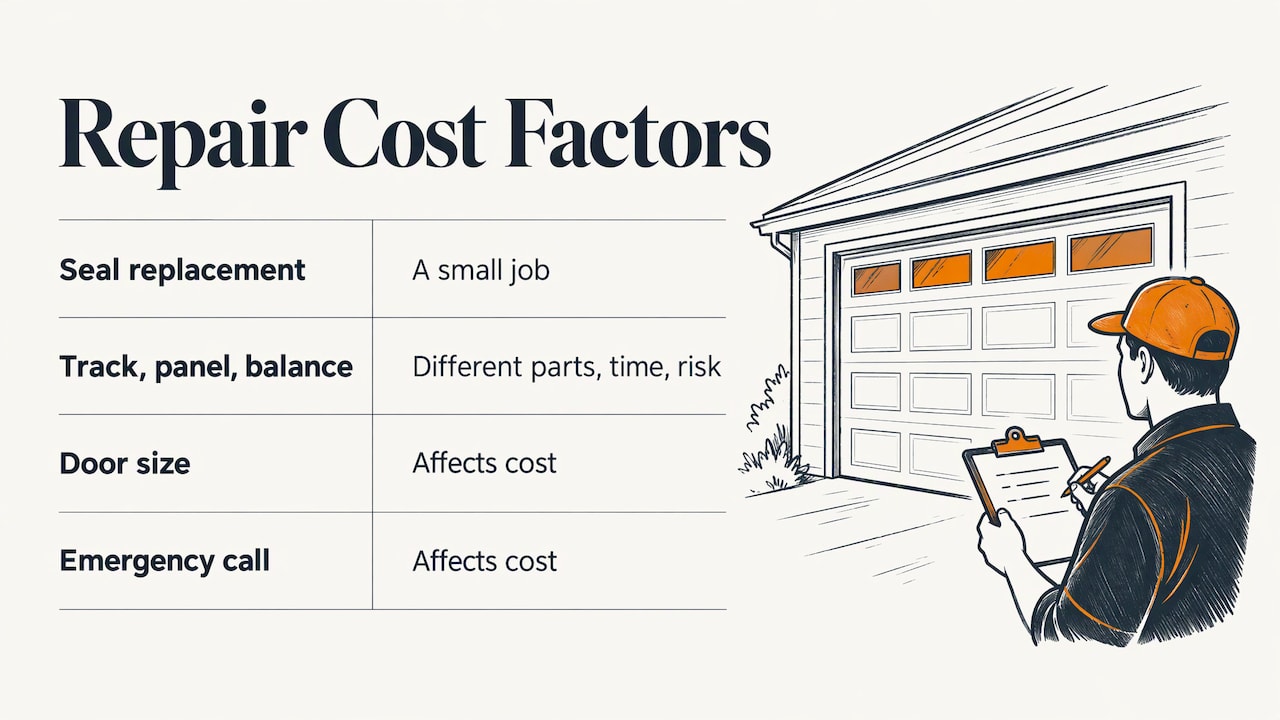
The best way to get a number you can rely on is to describe what you see and let a technician look at the door. Call us and we will give you a clear estimate before starting any repair.
Our perspective
Most calls we get about a gap at the top start with a weatherstripping question and end up as a door question. A seal is the cheap, visible part, so people replace it and the gap comes back. When we look, the cause is often a track that has loosened, a panel that has sagged, or a door that is not balanced anymore.
Our advice is simple. If the gap is even and the seal is worn, a new seal is a sensible fix. If the door is sticking, uneven or noisy, the gap is a symptom, and the right move is to have the door inspected before it gets worse. Springs and cables are under high tension, and we do not want anyone working on them without training.
We look at the whole system: seal, panels, tracks, springs, cables and opener. Then we explain what we found and give a clear estimate before we begin. That is how we like to work, and it is what we would want if it were our own garage.
Sean Smith
Get the top of your garage door checked in Colorado Springs
We are a locally owned garage door company serving Colorado Springs, Fountain, Monument, Woodland Park, Falcon, Manitou Springs, Pueblo West and surrounding communities. We handle garage door repair, spring and cable work, opener repair and installation, and new door installation for homes and commercial properties.

If your top gap is uneven, new, or paired with sticking or noise, call (719) 257-3379 to schedule an inspection or request an estimate. Start with our garage door repair page, or look at new garage door installation if the door is past repairing. If you are weighing a replacement for energy reasons, our guide to insulated garage doors in Colorado may help.
FAQ
Should there be a gap between the garage door and the wall?
There should be some clearance so the door can move freely, but not a large opening. A flexible seal should lightly touch the closed door and close that clearance. If the gap is wide, uneven or changing, have the door and tracks inspected.
What is the top seal on a garage door called?
It is usually called stop molding, trim seal or top seal. Some doors use a wood or vinyl stop with a flexible flap, and others use a separate seal on the top edge of the door. Matching it to your door type matters for a good fit.
Why does my garage door bind at the top?
Common causes include a seal fitted too tightly, shifted or bent tracks, a sagging panel and a door that is out of balance. Because an unbalanced door can drop unexpectedly, stop using it and call a professional instead of forcing it. We can help with doors that won’t open or won’t close.
Can I fix a top gap myself?
Replacing a worn top seal is a weatherproofing task that does not involve springs or cables, as long as the door runs smoothly. Adjusting or replacing springs, cables, brackets or tracks is not a homeowner job. Those parts carry high tension, so call a professional.
How much does it cost to fix a misaligned garage door?
It depends on the cause: a seal, a track, a panel or the balance system each involve different work. Door size, parts and emergency timing also matter. Call us at (719) 257-3379 for a personalized estimate.
Sources
- Garage Door Weather Stripping: Side and Top Seals, Stop Molding
- Garage Door Side and Top Seals
- DASMA: Drywall Surfaces and the Mounting of Garage Door Hardware
- ANSI/DASMA 102
- CPSC: Non-Reversing Automatic Garage Door Openers
- CPSC: To Save Lives Homeowners Should Replace Non-Reversing Garage Doors
- New York FACE: Maintenance Mechanic Killed when Improperly Installed Garage Door
- Chamberlain: Safety and Compliance
This article is provided for general informational purposes only. Garage door springs, cables, and other components can be dangerous to repair without proper training and equipment. For professional garage door repairs, contact Pro Spring Garage Door at (719) 257-3379. We provide 24/7 emergency garage door services throughout Colorado Springs and surrounding communities.