
A gap under a closed garage door usually comes from one of three things: a worn bottom seal, an uneven floor, or a door that is not closing all the way. A worn seal is the most common cause and the easiest to fix. A door that stops short, lands crooked or bounces back up points to a mechanical problem that needs a trained technician. This guide shows you how to tell which one you have, what each fix involves and when to call us at (719) 257-3379.
TL;DR
- The strip at the bottom of the door is the bottom weather seal. When it cracks, flattens or pulls loose, daylight, drafts, water, dirt and pests get in.
- The shape of the gap tells you the cause: an even gap with tired rubber means a worn seal, a wedge or a low spot means an uneven floor, and a crooked or short landing means the door itself needs attention.
- Never adjust, loosen or remove springs, cables or the bottom bracket yourself. They hold high tension and can cause serious injury.
- Costs vary with the door, the seal type and the cause, so we give a clear estimate before work begins.
- If your door is stuck or a spring or cable has snapped, we offer 24/7 emergency garage door service. Same-day appointments are subject to availability.
Table of Contents
- Is a small gap under a garage door normal?
- What is the strip at the bottom of a garage door called?
- How to read the gap: the shape points to the cause
- The light test: find where the gap really is
- Replacing a worn bottom seal
- Choosing a seal for an uneven concrete floor
- When the gap means something else is wrong
- Check the opener after any bottom seal or door work
- Our perspective: fix the cause, not just the gap
- Get the gap fixed by a local team
- Where we work
- FAQ
- Sources
Is a small gap under a garage door normal?
Some small variation is normal. Garages are not built to be airtight like the living space of a house, and a concrete slab is rarely perfectly flat. But a gap you can see light through, feel a draft through or watch water run under is a gap worth fixing.
Here is why it matters in a home along the Front Range:
- Energy and comfort. Cold air slides in along the floor, especially if the garage shares a wall with a bedroom or has living space above it.
- Moisture. Snowmelt and rain can push under the door and soak stored boxes or pool on the slab.
- Pests. Mice, insects and spiders look for exactly this kind of opening.
- Dirt and debris. Leaves, dust and grit blow in and settle on everything you store.
For property managers and landlords, a gap is also a tenant complaint waiting to happen. Fixing the seal early is a small job compared with the cleanup after water or rodents get in.
What is the strip at the bottom of a garage door called?
It is called the bottom weather seal. Some people call it the bottom seal, the rubber seal, the weatherstripping or, in the trade, the astragal. It is a flexible strip, usually rubber or vinyl, that runs the full width of the door. When the door closes, the strip presses against the floor and fills the small dips and humps in the concrete.
On most steel and aluminum doors, the seal slides sideways into an aluminum channel, called a retainer, attached to the bottom edge of the lowest panel. The seal has a bulb or T-shaped ridge on each side that locks into that channel. Wood doors are often set up differently, with the seal fastened to the bottom of the panel.
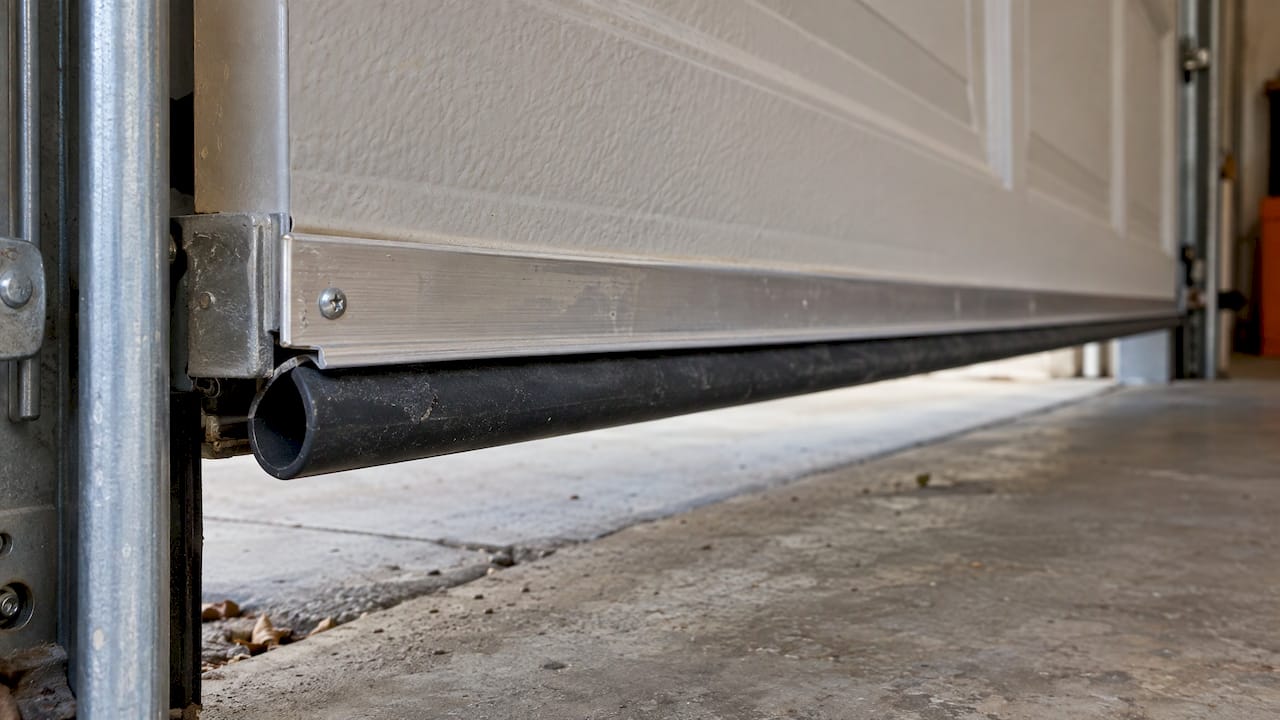
No seal, however good, makes a garage door watertight. Garage doors are built to keep out most weather, not to act like a sealed basement wall. A good seal in good condition does a lot, but it works best when the floor and the door are in good shape too.
How to read the gap: the shape points to the cause
Before you buy or order anything, look at the gap closely. Its shape is the fastest clue to what is going on.
| What you see | Likely cause | What usually fixes it |
|---|---|---|
| Even gap across the width, rubber cracked, flattened, brittle or torn | Worn bottom seal | New bottom seal |
| Seal missing in sections or pulled out of its channel | Damaged seal or retainer | New seal, sometimes a new retainer |
| Gap that grows toward one side, or a low spot in the middle of the slab | Uneven floor | Taller or bulb-style seal, or a threshold on the floor |
| One side lands before the other, or the door looks crooked when closed | Door out of level, cable or spring problem | Professional inspection and repair |
| Door stops short of the floor or bounces back up | Opener travel settings, track or hardware issue | Professional inspection and repair |
If your door matches the first two rows, you are probably looking at a straightforward seal replacement. If it matches the last two, the seal is not the real problem, and a new one will not close the gap.
The light test: find where the gap really is
The easiest check takes about five minutes and needs no tools.
- On a bright day, close the door completely.
- Turn off the garage lights, and close or cover any windows in the door if you can.
- Walk the full width of the door inside the garage and note where daylight comes through.
- Look at the bottom edge, then run your eye up both sides and across the top.
Light along the bottom only suggests a seal or floor issue. Light along the sides or top as well suggests worn perimeter weatherstripping, which is a different part. If you see light at the top, our guide to the garage door top gap covers its causes and fixes.
One more check: on a cold day, hold the back of your hand along the bottom edge and see whether you feel moving air. Reviewing the door every month or so, including a quick look at the seal for cracks, tears or flattened spots, catches most problems early. You can spot the signs it is time to replace the seal in three ways: daylight under the closed door, a draft, or water coming in when the outside of the door gets wet.
Replacing a worn bottom seal
If the seal is the culprit, replacement is one of the more routine garage door repairs. Here is what the job involves, so you know what a good result looks like.
- Secure the door. The opener is disconnected from power and the door is held in the raised position so it cannot drop.
- Open the retainer ends and remove the old seal. Brittle seals can fight back, so a little soapy water helps them slide out.
- Clean the channel. Dirt, old rubber and grit in the retainer make the new seal bind or sit crooked.
- Feed in the new seal. The locking edges go into the channel, usually with soapy water as a lubricant, and the seal is centered and trimmed to length.
- Close the ends and lower the door by hand. The seal should touch the floor continuously across the full width, with no daylight showing.
The right replacement depends on your door. Seals come in different profiles and widths, and the retainer on your door determines which style fits. A seal that is the wrong profile will slip out, wrinkle or leave gaps, which is why many homeowners prefer to have the correct part identified and installed in one visit.
Notice what this job does not involve: springs, cables or the bottom bracket. On many doors the bottom bracket holds the lift cable under load, and loosening it with spring tension on the door can cause serious injury. If your seal job looks like it would require touching any of these parts, stop and call a professional.
Choosing a seal for an uneven concrete floor
A flat, level slab is the exception in many older garages, and settling, frost heave and sloped driveways all play a part. When the floor is the reason for the gap, a plain flat seal will not solve it. A few principles help.
- Measure in more than one place. Close the door and check the gap at the left edge, the center and the right edge. The largest measurement is the one you need to solve for.
- Match the seal profile to the gap. Bulb-style and T-style rubber seals flex to fill small gaps. A bigger gap generally needs a taller seal.
- Know the limit of a bulb seal. A standard bulb seal only compresses a fraction of an inch. A noticeable dip in the slab deeper than that can leave a gap that no ordinary seal will close.
- Consider a threshold for deep low spots. A rubber or aluminum threshold bonded to the floor raises the low area so the existing seal can make firm contact.
- Think about temperature swings. Colorado weather can run from hot afternoons to hard freezes in the same week. Rubber that stays flexible in the cold holds its shape better than stiff, cheaper material that takes a permanent set.
If water is the main concern, floor shape matters as much as the seal. Water running toward the door will find its way past almost any seal. Sloping the slab slightly away from the door, or setting the door to rest in a shallow notch in the concrete, addresses that. This is a conversation to have with a technician who can see your driveway and slab in person.
When the gap means something else is wrong
Sometimes a gap is the first visible symptom of a mechanical problem. Watch for these signs:
- One side hangs higher than the other. A stretched, slipped or broken cable can leave one side of the door sitting higher. Read more about what to do about a broken garage door cable before you try to run the door.
- The door feels heavy or the opener strains. A weak or broken spring makes the door much heavier to lift. See what to do right now with a broken garage door spring.
- The door stops short or reverses. If the door will not complete its travel, our page on a garage door that won’t close walks through the causes and which ones are safe for you to check.
- Panels are bent or the bottom edge is damaged. A bumper hit or dent can distort the bottom section so the seal cannot sit flat. If that sounds familiar, read what to do after you hit your garage door.
Springs and cables operate under high tension. Do not try to adjust, loosen, remove or replace them yourself. A professional has the winding tools, the training and the right replacement parts for your specific door. If a spring has already snapped or the door is stuck open or shut, call us any time: we offer 24/7 emergency garage door service, and same-day appointments are subject to availability.
Check the opener after any bottom seal or door work
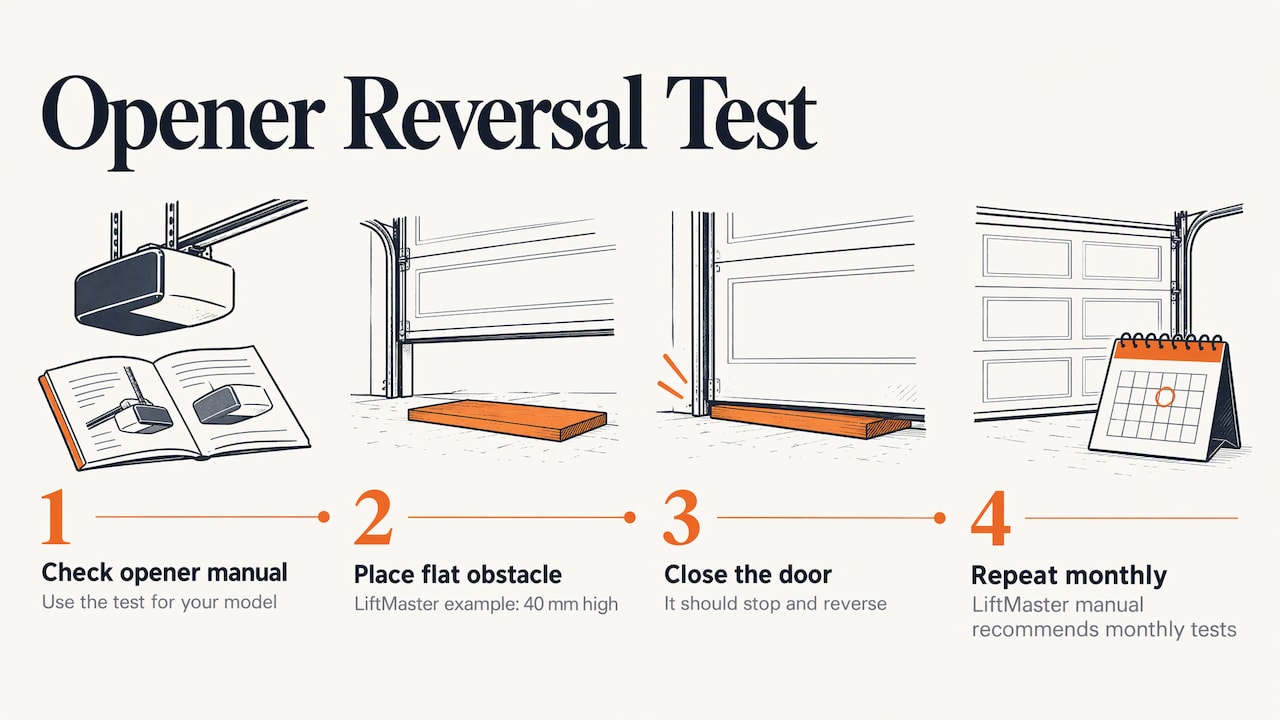
A new seal changes how the bottom of the door meets the floor, and the opener’s down-travel and safety reversal need to still work correctly. The door should reverse when it meets an obstacle. One LiftMaster manual, for example, states that the door must reverse on contact with a 40 mm obstacle placed on the floor, and that the safety reverse test should be repeated once a month. Your opener’s manual lists the exact test for your model.
A simple version of that test is to lay a flat object, such as a board, under the door and close it. The door should stop and reverse when it touches. If it crushes the object or keeps pushing, stop using the opener and have it looked at. Regular garage door safety inspections include this kind of reversal check as a routine part of maintenance.
If the door will not reverse properly, or the opener is old and struggling, read about how long garage door openers last. We handle opener repair and installation for homes and businesses throughout the area.
Our perspective: fix the cause, not just the gap
We see the same pattern often. A homeowner notices a gap, tucks a strip of weatherstripping into it, and a few months later the gap is back. The strip was never the problem. The floor dipped, or the door was landing crooked, or a cable had stretched.
That is why we start by looking at the whole door before we talk about parts. A worn seal is a quick, simple fix, and we are happy to do it. But if the gap is a symptom of a spring or cable issue, replacing the seal alone leaves the real problem in place, and those parts hold high tension that is not safe for untrained hands.
We believe in clear estimates before we start work, quality replacement parts and professional workmanship. Because every door, floor and budget is different, we do not quote costs in articles. We look at your door and give you an estimate for that specific job.
If you are a property manager or landlord with several doors, tell us. A quick walk through each door often catches worn seals before tenants call to complain.
Sean Smith
Get the gap fixed by a local team
Pro Spring Garage Door is a locally owned company serving homeowners, property managers, landlords and businesses in Colorado Springs and the surrounding communities. Whether you need a new bottom seal, a door that closes properly again or a full garage door repair, we look at the cause first and give you a clear estimate before work begins.

If your gap turns out to be one symptom among several, and the door is old, a replacement may make more sense than repeated repairs. Our new garage door installation service covers residential and commercial doors. Call (719) 257-3379 to describe what you are seeing and request an estimate. Same-day appointments are subject to availability, and emergency service is available 24/7.
Where we work
We serve Colorado Springs, Manitou Springs, Fountain, Monument, Woodland Park, Falcon, Black Forest, Gleneagle, Peyton, Cimarron Hills, Larkspur, Perry Park, Pueblo, Pueblo West, Florence and other communities across El Paso County and nearby. If your address is on the edge of that list, call and we will confirm whether we can get to you.
FAQ
How do I fix the gap under my garage door?
Start by finding the cause with the light test and by looking at the seal. If the rubber is cracked, flattened or torn, a new bottom seal that fits your door’s retainer usually closes the gap. If the gap is uneven because of the floor, a taller seal or a floor threshold may be needed. If the door lands crooked or stops short, call a professional rather than adjusting springs, cables or brackets yourself.
How much does it cost to fix a misaligned garage door?
It depends on what is causing the misalignment. A loose track, a stretched cable and a worn spring are different repairs with different parts and labor. We do not publish prices in articles, so call (719) 257-3379 and we will give you a clear estimate for your door before we begin.
What is the best garage door bottom seal for uneven concrete floors?
A flexible rubber bulb-style or T-style seal sized to your largest gap is the usual starting point. Measure the gap at the left, center and right of the closed door. If a low spot is deeper than a standard seal can compress, a threshold on the floor works better. A technician can match the profile to your door and your slab.
Can I change a bottom seal myself?
A seal sits in a channel at the bottom of the door and does not involve the spring system. Still, the bottom bracket and lift cables hold high tension, and the door must be secured safely first. If anything about the job looks like it touches the spring, cables or brackets, leave it to a professional. We can handle the seal and check the rest of the door at the same visit.
Sources
This article is provided for general informational purposes only. Garage door springs, cables, and other components can be dangerous to repair without proper training and equipment. For professional garage door repairs, contact Pro Spring Garage Door at (719) 257-3379. We provide 24/7 emergency garage door services throughout Colorado Springs and surrounding communities.